I'm incredibly late on posting: The blizzard has come and gone into slushy mush, and by all accounts, the phrase "the best time to experience New York is during a snow storm" is verging on cliche. It was great that so many people were out to enjoy the snow.
We went sledding in Central Park, a repeat of what we did during last year's big snow storm. I love that the Parks Department prepares by putting out bales of hay at the foot of any large hill, in anticipation of sledders. Sledding is really the only time in the city when sharing a rare commodity - a good sled - is de riguer and knocking people head over heels is appropriate -- nay, expected! I didn't take any pictures myself, but from the numerous flashes that were going off in the gloaming, I couldn't wait to see what was posted. Here's a few of the best off of Flickr.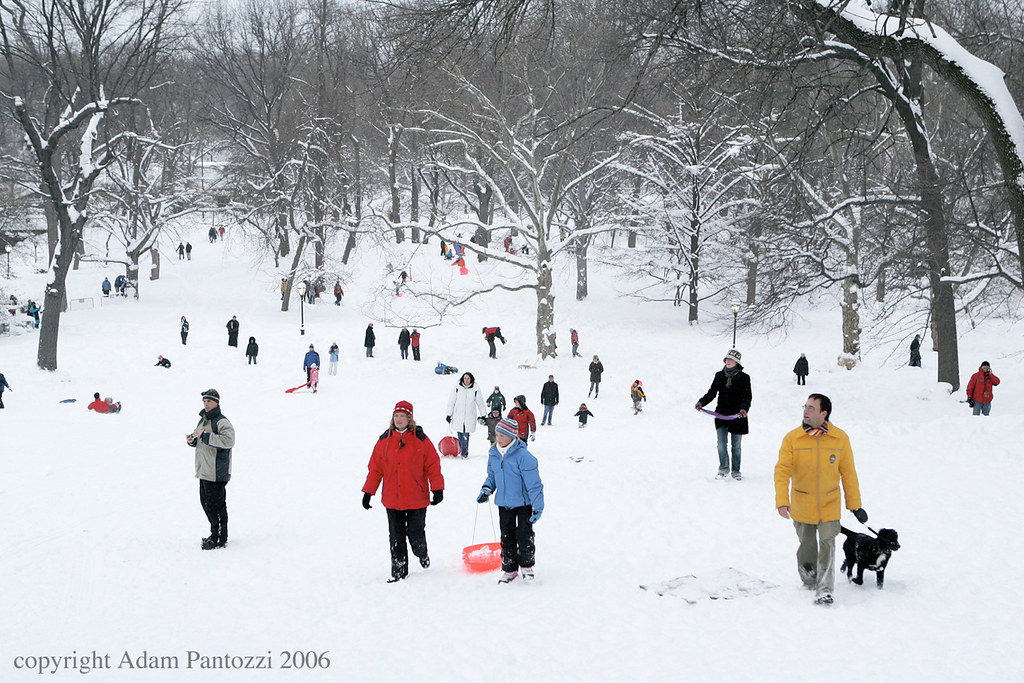
by Adam Pantozzi
from drewbic gallery
Another from drewbic gallery. Watch out!!!
2.14.2006
Belated snow
2.10.2006
On target - Spanish architecture

Morphosis Housing Complex, Madrid, Spain
I went to a preview of the new exhibit of modern Spanish architecture at the Moma this week (the page has a good audio tour explaining the rationale behind the selection). I love how daring Spanish architecture has been of late. It appears in my mind's eye as colorful and whimsical. I was also really excited to see the Moma without the weekend crowds. I personally love people in the building, but many people don't and some have issues with the building layout itself.
The exhibit itself was really fun. The buildings were shown at a few different scales to provide profiles up close and from afar.
The architecture was fascinating, yet were not always the most colorful, whimsical or livable designs. There were plenty of buildings that looked beautiful from about the second story up, but unfortunately were pretty blank and non-descript at ground level. As a pedestrian, it wouldn't be something I would want to walk next to or live next to, though looking at models from that seemingly standard architecture/art model height of about 50 feet taller than the height of the building, many of the buildinsg showcased looked magnificent and forward.
Has beauty been divorced from function in the architecture world? Only 18 of the 35 buildings showcased were complete - the proof is in the pudding. I would love to visit these buildings and see if impressions based on the models are accurate.
2.09.2006
Living Streets

An "after" pic depicting the beautiful potential of Astor Place
If you missed the Livable Streets gala this past week, the exhibit will still be up at the Municipal Art Society's Urban Center through March.
Here's a trailer of what the exhibit is all about.
2.08.2006
Homage to Jane Jacobs
...and some good post-war "urban renewal" history too. A very nice way of getting introduced to Jane Jacobs.
2blowhards's Jane Jacobs via curbed.
2.07.2006
Street Foodies Unite!
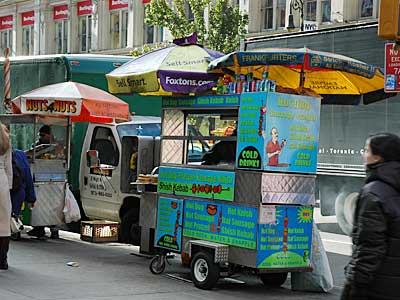
Image from urban75
This has been posted and sent around, but just for my reference, I also wanted to give some space to Platial. It was noted initially for its ability to generate a street food map (I suppose I should submit the obvious oversight of the Dosa Guy in Washington Square Park), but I like that it is simply a democratic way for people to mark their favorite vernacular places. All Google Maps carry an element of that, but the purpose behind the site says more. I like that it does so in a sensible way, less W. Benjamin-y than glowlab, though I like that technique too.
I for one can't wait until someone with enough time and energy and tech know-how maps these great places, since the descriptions that people send in are so fun.
Round-up on Detroit
There's a report card of sorts on how Detroit fared with hosting the Super Bowl. Did it hit its economic goals? Check out Detroit Free Press to find out.
And for another bout, of a completely different sort, Richard Layman, a native Detroiter, offers thoughts on Detroit, and picks up a couple of things from Seattle, here, here and in general, if you couldn't tell, he's extremely prolific and brings in thoughts on Detroit in many posts. I confess I can't always keep up, but it's always an interesting read.
1.30.2006
Who's in charge of sidewalks?

Look at that narrow median and barely existent shoulder on Bowery! Not seen here, the sidewalks are wide, crossing the street is what remains difficult. Image from Flickr, by antiparticle.
I thought this vignette well illustrated the lack of coordination in our streets. I believe sidewalks are a part of the street. But with no one taking responsibility, then...
Speaking of which, walking my dog has been a good experience in learning about good and bad pedestrian harbors. The median on Bowery between 4th and around Grand is just pathetic. Cybill S., a non-skittish, skinny dog, uncharacteristically cowers at approaching traffic, because she cannot stand in the median without some part of her in the traffic lane. The cars speed, taking advantage of the wide lanes. And there's barely any shoulder, so truck tires really do feel like they are running you down. I'm afraid that the same changes are going in for the median on Houston between Bowery and Broadyway.
These are wide streets with great sidewalks! They could be so much nicer, with a boulevard effect. If only.
Update: Polis weighs in on the matter!
1.27.2006
Downtown Detroit

Image from City Skip
For the last two years, I've been following the reaction to the new Campus Martius Park. Partially it was because it opened just as I started working on public spaces. Also, it was one of those projects that is a huge risk for the city to invest in when they had many other economic development issues to take care of (and were in the process of taking care of). But the hope was that a park would stimulate externalities to support other city-wide economic development efforts. Last summer, the project manager for the park showed us some of the effects of the park, whose presence strongly encouraged development on its outer boundaries (cafes, and it seems now inevitably, loft condos). This what we hoped would happen in the short-term.
Lately, there's been even more coverage about the city, since it's sprucing up for the Superbowl, and because this is Detroit, the coverage has not be entirely positive. Reports make the city sound a bit desparate. Look at "Come on in," and "Detroit Cleans Up for the Big Game." The AIA has gathered together Detroit-area architecture firms to deck out storefronts. (I like the idea.)
Anyway, I guess what I'm doing here is sticking up for the underdog -- Detroit, which has some fantastic civic leaders who have been strategizing and planning for a revitalization effort that will bring the city back to the people. I don't think this is a city-wide sentiment yet, but I like the incremental steps that are being taken. Better that as a way to see what works than huge capital projects in one fell swoop (into debt).
For more on Detroit, you should read all about it from a native Detroit-er who writes about these issues, Rebuilding Place in the Urban Space.
Good luck Detroit!
1.24.2006
Waxing architectural
I really enjoyed this diatribe.
Bad writing about architecture makes me appreciate one of my heroes even more: Ada Louise Huxtable. What I really like about her is that she's sensitive to context, and is willing to change her views with changing times - she's not for or against anything just because.
1.18.2006
A vision for NYC transportation
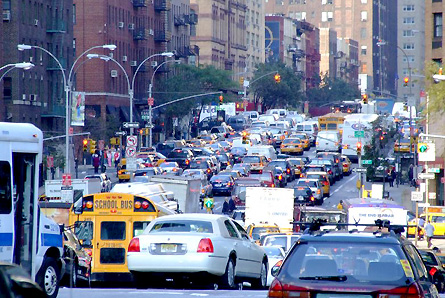
Image from Gotham Gazette
I got this Gotham Gazette article sent to me about 4 times this morning, so it's the must-read of the day. (And the Issue of the Week on the Gazette).
It's just terrific to see how multiple advocacy organizations are banding together and trying to define an alternative to NYC transportation as we know it. It's also wonderful that there's mass appeal to city-wide leadership.
However, I'd like to see the focus of discussion shift from cars (e.g., more cars, less cars, less congestion, through-out, level of service, etc.) to something that says we'd like make our streets more friendly for bikers and pedestrians. Something that includes the people who travel the streets, like we'd like to make our roads the kind that children and seniors can cross safely.
When we constantly define success within the parameters of what already exists, it gets nearly impossible to create transformative change. For example: NYC DOT, and many other transportation agencies, defines agency success by what's called "level of service." Level of service is primarily driven by how well the roads service vehicular transportation. This typically implies that congestion is bad. But it's not always bad. Congestion in an urban context used to be considered good. (West Palm Beach has changed its understanding of level of service to be that congestion in the city center is actually good! If you're a wonk, check out this report, opens in a PDF.)
Still, this says nothing about the other 80% or so of the travellers in NYC -- the walkers, transit riders, and bikers. If we don't start looking beyond the end of our nose, we'll constantly struggle to come up with some different way of defining good performance, and we'll consistently stay pretty much the same. Sure, there will be incremental change along the way - a spot victory here and there, like a sidewalk widened or a bump-out added or a bike lane painted, but how much longer can that level of struggle be sustained? Isn't it time we just come together and really understand: what do we want our city's streets to look like?
This can be done. Think of Copenhagen, which went through a multiple decade process, starting in the early 1960s. Or London, which recently went through its own street (and public space) renaissance. Instead of prematurely offering another transportation solution (congestion pricing, value pricing, bridge tolls, etc.) how about we offer a transportation vision, and consider transportation our bikers, bus- and train-riders, and pedestrians -- as well as our drivers.
This takes some change at all levels. Advocacy/grassroots groups need to continue to be as strong as they are, but also offer alternative ways of looking at transportation and think beyond the traditional transportation street paradigm. Planning and transportation professionals should think beyond performance metrics as laid down by the Green Book, and think about the community goals they can contribute to -- with streets as the main tool. And leadership should think beyond the narrow band of political agendas and create a broad vision for their communities, districts, cities, and yes, regions.
1.15.2006
Country Boys


Cody Perkins (top) and Chris Johnson from Country Boys
In addition to the discussion brewing on Gehry and the Atlantic Yards project, I've been obsessed all week with the latest Frontline special, Country Boys. You can watch the entire program from the web site, if you missed it.
There's something I love about this glimpse into the inner life of two boys, Chris and Cody, trying to grow up in Appalachian Kentucky. This gets more personal than I've been on this blog. I'm not sure if it's my own family's rural and humble roots (albeit in another country), or my own struggle to belong when I was growing up here as a new immigrant, or the experience of having to grow up quickly, which is typical of new immigrant children, and which intensified when my sister and I decided to stay in the United States while my parents decided to return to their home country, just as I started high school. I grew up in a privileged community, so watching Chris explain what it was like to pay bills and take care of the house while handling school work was the first time I saw my embarrassment, but in another, and completely different person.
The other thing I pay close attention to when I get a chance to get close to another life is how people live their days - how they get to work or school, what they do in their free time, how they get their groceries, run everyday errands, how they choose to get together and meet other people. I'm sure that what the two boys did was not entirely emblematic of everyone's lifestyle in Eastern Kentucky, but it was fascinating to see how hard it was for them just to see...anyone. And in a rural area where people are few and far between, it seems even more important that people who do live there have places to gather. This is a kind of revelation I experienced when I moved from a generally rural/suburban area to a more metropolitan area for the first time. In the city, through my everyday routine of walking to work, getting coffee and breakfast, getting groceries and schlepping them back to my tiny studio apartment, I realized that I wasn't as lonely as I had been in the suburbs, even though I knew absolutely no one in the city.
I don't think everyone needs to live in urban areas. I just think that we haven't been paying the right kind of attention to suburbs and rural areas, which should also address basic needs and in a socially constructive way. Regardless of environment - urban, suburban, rural - everyone needs to buy groceries, go to work, go to school, run errands, and see people every once in a while -- no matter who we are.
1.10.2006
Gehry in New York

And on Brooklyn. As part of TimesTalk, a speaker series hosted by the NY Times, Gehry was in town and took questions from an audience, moderated by Nicholai Oussourroff. There's a great, though very biased pretty much focused on Brooklyn, report from the talk on TimesRatnerReport. (via Veritas et Venustas, via Curbed).
The statement that stuck out for me was from Peter Krashes, president of the Dean Street Block Association, who said to Gehry,
"We don't want you to turn your back on us, as an architect. What we want you to do is explain your role as a planner."Architects do design for large contexts - their designs don't end at the building edges - so it is worthwhile to really understand the urban context, especially for those who profess to be "do-gooder, lefty types." I have always felt that Gehry just didn't get what he was doing to Brooklyn's Atlantic Yards neighborhood, either by not asking enough questions from the people he's working with, or by simply not having the experience of asking. This talk corroborates my impression. Or perhaps it's more simple: ignorance is bliss.
I'm looking for a more pro-Gehry account of the talk, but nothing has shown up yet. Let me know if you see one!
1.05.2006
Wal-Mart Realty

116,924 sq ft building available in Niagara Falls, NY
Kevin left a comment in my last post, letting us know about abandoned Wal-Marts FOR SALE. Now you can see where they've forsaken a community promise, or are planning to -- I noticed a few "Available in 2006" properties. There's one in Camillus, close to my hometown!
[I hate that the comments are so hidden, but I do read them! So please write.]
Also, I've posted about this before, but check out Big Box Reuse to see how people are reusing these big boxes. There aren't many new re-uses since the last time I checked over a year ago. Any ideas on what's going on with the Wal-Mart properties "Under Contract"?
1.04.2006
Abandoning Wal-Mart
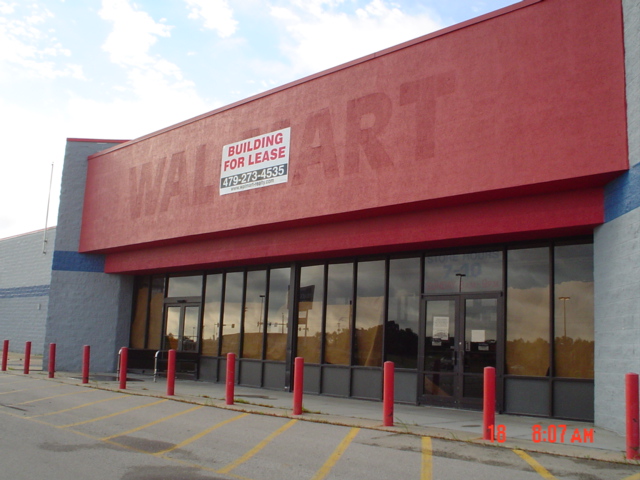
Abandoned Wal-Mart store in Oskaloosa, Iowa courtesy of flickr
Wal-Mart is abandoning the U.S., more like it.Last night, PBS re-ran Frontline's November 2004 report "Is Wal-Mart Good for America?", a program worth revisiting. It shows how Wal-Mart's business practices are tied to globalization and international trade, and how it has sold out the American Dream for corporate profit.
Also covered in the program is Wal-Mart's forcing of the hand of a new corporate ethic: instead of the high value, high innovation differentiator -- which had been the reputation of the United States for a long time (speaking from my immigrant background) -- Wal-Mart's playing the lowest price, lowest cost differentiator. Also, Wal-Mart's influence on national economic development in China is phenomenal, but not at a net benefit to the US. Just goes to show that those who dismiss the link between city planning and internationalism are missing some key indicators.
The Frontline report was a good follow-up to the viewing of The High Cost of Low Price over the holidays. Despite the poor execution (I wish I didn't have to say so, though many thanks to the volunteer film crews, check out the story behind the movie to see what I mean), the film had enough facts and data to make me believe even more strongly that Wal-Mart is systematically destroying the social, economic and built environment that has made this country. The anecdote that stayed with me is told by one city manager. Essentially, Wal-Mart has enough start-up capital that it never has to respect the term limits of its tax abatements: all it needs to do once it has reached its term limit is to shut down the old store and build a new one just beyond the taxable border. Just beyond is fine...Wal-Mart'll seal a deal with the neighboring town to suck it dry and not pay taxes.
Those poor city managers. The city manager said he had no choice: either he accepts Wal-Mart's terms, or Wal-Mart will go and build its store just outside the town border and suck the town dry anyway, without any of the meager residual benefit it gives within town limits. There's the datapoint floating around that there are around 300 abandoned Wal-Mart stores in the US.
12.29.2005
How people get to work...

Image from Transportation Alternatives
...during a transit strike. There was so much coverage about the transit strike in New York City that I didn't bother covering it, and I'm too ignorant to partake in a discussion about labor rights. However, we started a discussion on PPS about how people got to work and there are some good comments there.
I like to see how the everyday plays out in the city, so how people got to work interests me, and the event had varied results. We had one intrepid staffer who took 4 modes of transportation to get here: walking, car, water taxi, then taxi. Then we had other people who didn't want to come in because their bike tires were flat and they couldn't face 45 minutes of riding in the cold. Having no subways running is highly inconvenient, to be sure, but it seemed that city travel is a lot about the state of mind, and whether one is up for it...or not.
Honestly, I thought that NYC, given a transit strike, was much better off than most American places in that the structure of the city offered many options for commuting, even if the subway was down. Biking wasn't happening along fast 4 to 6 lane highways as it might in other sprawl-ridden communities - from Brooklyn and Queens to Manhattan, it happened on city streets and across bridges, many of them with bike paths. The city was able to open up major thoroughfares in Manhattan to bikes with little effect on traffic. It was a great chance to view our city under a different light. What would happen if we made our bike paths wider? If there were fewer cars? If more people walked?
Perhaps this is too positive a perspective to take, and I certainly wouldn't want another transit strike -- we were lucky that it lasted only a few days -- but I thought overall it was great to see all the activity in the street throughout the day.
And, please treat the transit workers with respect. They are people like you and me who have to commute to work too. That they make our commute so much easier deserves credit.
12.28.2005
"Old-style" shopping
To me, it's no surprise that traditional malls are facing a backlash of sorts. If it's not the trouble it takes to get to a mall that's preventing people from going to malls, it's also the increasing demand for unique services and goods from places that come from mom-and-pop-run stores. Those are the types of stores that have the freedom to make their own imprint on a consumer's experience.
I just loved this Cinncinnati story about old-style downtowns. What I especially liked was this:
"We don't do malls," declared Aurelia Rice of Fort Mitchell. "We come here and kind of make a day of it."The "lifestyle centers" that are popping up in regions of fastest growth (California, Florida, Southwest) are a reflection of this demand for old-fashioned downtowns. I read signs in other small ways. The trendiest shops in the East Village offer what seems to be cutting edge nostalgia, the latest in consumer contradiction. They're selling icons and signs from old-fashioned stores...just take a walk through the neighborhood and check out the old being sold as the newest new.
12.18.2005
Affording and living the daily life

I loved this NYTimes article (by Polis) about the innovative ways San Mateo County (Silicon Valley region) community is trying to provide housing for its teachers. How about applying similar solutions for firefighters, policement, and other people who provide priceless services in other communities?
I especially like that there are also affordable home ownership programs for the teachers, so they are encouraged to buy and can settle into the school district and not leave once they outgrow the apartment.
And, to boot, one teacher mentioned off-handedly that she likes that she can walk to the grocery store. So, it's not enough to provide housing - how about providing housing in places that don't require so much driving. Another good Sunday Times article, "In the Exurbs, Life Framed by Hours Spent in the Car", outlines the cycle of exurb development.
That phrase neatly captures my belief that all this extra driving doesn't only impact commuting and traffic congestion, but it greatly influences quality of life. People are moving out to the exurbs looking for better places to raise their families, more house for their money, etc., yet they can't actually experience those benefits spending so much time getting to their jobs, which are increasingly farther away. I talked about this earlier in June about families that specialize in relocation.
12.16.2005
Living within our environments

Madgeneral has an eloquent, thoughtful post about our natural and built environments, our habits as modern day humans and our shifting role in the ecological web. I can't get it all down here, so go read it!
12.14.2005
"Together Alone"

I didn't get a chance to read all of the great ideas of the year, but I listened to a description of a new type of relationship, the "fleeting relationship," which reminded me why public spaces are great. The fleeting relationship is exactly why it is fun to hang out in a coffeeshop by yourself, sit on a park bench, smoosh into a crowded subway -- basically, live in our public spaces. The thing about fleeting relationships, as fleeting as they are, is that they need places to occur - the softball field, a bar, a gym - all grounded places.
I'm glad people are studying this. My architecture, landscape architecture, geography, etc friends have found it incredibly difficult to make headway in this field in the traditional academic disciplines. It reminds me to add Robert Putnam's "Bowling Alone" and "Better Together," with Lewis Feldstein, to my wish list. Places don't necessarily determine the interaction, but they really make those positive relationships so much easier to form.
12.06.2005
Whose fault is it
In a mildly ironic twist, Charles Atherton, the former longtime secretary for the Commission of Fine Arts (he oversaw the design of major monuments and buildings) was struck by a motorist in DC and then issued a summons (with a $5 fine) for jaywalking before being whisked away to the hospital.
There was some speculation as to why the police offer was so adament about handing out the summons. The best explanation is that he was trying to assuage the distraught driver in pinpointing blame. Regardless,
"He was issued a ticket because he was at fault. That's all I can tell you," said Lt. John Kutniewski of the police department's major crash investigation unit.What?! Pedestrians should have the right of way, even when they are crossing outside of the crosswalk. No one deserves to be hit by a car.

72nd street station during improvement construction in 2001
The design of streets sometimes make it harder to cross at crosswalks. A small example in point: I was looking out a 34th floor window at a friend's place at W. 70th Street, the intersection where Amsterdam and Broadway cross. A few of the crosswalks definitely favor cars, harboring more cars at the intersection but forcing pedestrians to cross at a long diagonal. Walking across the intersection would be tedious without the wide refuge of the 72nd street station, and at the south part of the intersection, where there is no refuge, you have to keep on trucking across four lanes. I think this crosswalk went through an "improvement" just a few years ago. Crossing mid-block would be the most reasonable place to cross from my 3mph speed. Given the millions of people who travel at that speed, don't they deserve "right of way" when compared to the mere thousands of cars in the city?
Update: Some sad news. Richard Layman of Rebuilding Place in the Urban Space just told me that Charles Atherton passed away today. So unnecessary...
On roadwitches

How about a "roadwitch" for some calm? BBC reports that Ted Dewan, a British children's author and traffic campaigner is spearheading "DIY-traffic calming." The purpose of his campaign, done through whole living room sets on the street, down to the carpet, is to challenge drivers' entitlement to speed and urban space.
"My daughter isn't allowed to throw snowballs at school, because it's considered too dangerous. But it's meant to be acceptable that she can walk home only inches away from cars driving at lethal speeds. There is something weird about this, a deep cultural bias."...A similar campaign has been led by David Engwicht, who sits on a royal throne in the middle of the street to slow cars down. Check out Lesstraffic.com.
As the owner of two cars, Mr Dewan says he's far from being anti-motorist, but he wants "mutual respect" between drivers and pedestrians and to stop the "deluded, selfish" way that traffic has come to dominate urban spaces.
12.05.2005
Not really a public Bryant park
There's a lot of coverage about this little fact - our beloved Bryant Park gets no public money.
The NYTimes article - the reporter did a great job dissecting the deal Bryant Park got in the mid-1980s
Gothamist opines, and so does Curbed.
PPS thinks Bryant Park is Great and a Shame. Read its entries as a Great Public Space and as a Hall of Shame. And finally, PPS's thoughts on the commercialization of public spaces here and here.
Belly by Lisa Selin Davis

I had the pleasure of meeting Lisa Selin Davis when I started here a couple years ago. Thanks to theboxtank, I was reminded of her new book, Belly. Read also the funky Gothamist interview with her, where she gets right down to business,
"If you drive along I-95, you see these carcasses of cities, all these disastrous urban renewal projects that tore out the architectural heart of cities -- "slum clearance" -- and replaced them with these uniformly ugly modernist towers, what I call the architecture of intolerance. And that's what I think they're doing to Brooklyn: making it look like Anywhere, USA."
11.30.2005
Wal-Mart is not an anti-poverty program
This week, John Tierney's weekly NYTimes column takes issue with Wal-Mart critics. Instead of accelerating poverty in local communities, as many Wal-Mart critics have proposed, he claims that Wal-Mart is in fact responsible for helping to alleviate poverty. First, Wal-Mart jobs are highly competitive - there are hundreds of job applications for each open position at a new Wal-Mart. Then he cites a study completed by a visiting NYU professor, which found that the low- to middle-income families that shopped at Wal-Mart saved at least $800 per year from the lower price index, compared to other shoppers who might have patronized Target (the middle price range) or Costco (the most expensive of the three).
Well. Wal-Mart jobs are highly competitive among workers because Wal-Mart tends to drive out competition among employers. Second, no one disputes the lower prices that Wal-Mart offers, but I find the price index comparison a shallow measure. In measuring cost-savings of only the cost of the goods purchased, it doesn't take into account the cost of taking advantage of those goods - gas, time spent driving to Wal-Mart, and the social cost of having Wal-Mart replace the community network. All of these are quite expensive in the long-run.
Wal-Mart is at best a short-sighted alleviation of poverty. More significantly, it erodes many options of creating wealth for lower-income families by turning them into the workers and customers of the same large corporate machine - and the one that has replaced their community.
Thanks to TimeSelect, you can't read the article. A search for the text turned out to be fruitless, and I guess most bloggers aren't blogging about this because the article isn't available. I guess I'm the only sucker.
Water, pavement and streets

I know that this site is primarily about our human-built environment, but I thought this fabulous Washington Post article, "Silent Stream," does such an excellent job of showing how our built environment impacts our natural resources that it's worth reading, even for the simple reminder of how interconnected our built and natural ecosystems are. (I also loved the anecdotes about inter-jurisdictional collaboration that's required to monitor streams effectively.)
For a long time, one of our champions at NJDOT had raved about stormwater run-off and how transportation engineers should pay attention to it. After reading this article, you'll be strongly reminded that anyone involved in any aspect of the built environment should be keenly aware of the co-dependencies of our environment. A flip of a butterfly's wing doesn't need 3,000 miles before it morphs into storm.
11.18.2005
Homeowner Associations

A while ago, someone left a slightly angry and puzzling comment here blaming home owner associations for being bossy (and suggesting that they obstruct housing developments? Confusing...)
Guess the reader was right with regard to bossiness, but not everyone is opposed to being bossed around by their neighbors (that is, everyone who is most likely white, privileged and can afford to purchase a new single-family property in a hot new development and whose neighbors are of a similar demographic). A new study by economists at George Mason University suggests that there is great value placed on homeowner associations in new housing developments. It also suggests that people want to be regulated - but not by state or even county/city officials. They want to be regulated by their neighbors.
John Tierney commented on it this week in the NYTimes (a digression: TimesSelect is one of the worst decisions NYTimes Direct has made, how much revenue can this subscription really generate?), speaking from his own experience with his neighborhood. Thank goodness for syndication - here's the op-ed re-run in the Rutland, VT newspaper, without the byline.
Thanks Kayx!
11.17.2005
If IKEA wants to be in NYC

...then I wish they would set up in a transit-oriented development, like this one being planned for Portland, OR, instead of out in un-transit friendly Red Hook. They could offer flat fee delivery - a la Room and Board - to the five boroughs, and lessen their effect on congestion/parking/emissions.
Toronto Transit Wants You

Toronto Transit Commissioner Howard Moscoe
I love this idea. The Toronto Transit Commission has launched a competition, appealing to its riders for ideas to add pizzazz to its system, ways to liven up the experience of taking public transit. The prize is one of twenty TTC Adult Metropass. Canadians have a great sense of humor.
Speaking of Canadians, Spacing in Toronto has released its latest issue, The New Beautiful City. Check it out here, opening party on November 24. Wish I could be there!
11.11.2005
Street bratwurst wins!

Rolf Babiel, king of the street bratwurst, won the Vendy Award out of four finalists and 200 applicants!
Congratulations Rolf!!
(Those who want to try the winning cuisine, his cart is on 54th near 5th.)
A great idea!

Congestion pricing in New York City!
Just looking at time lapse footage of pedestrians trying to cross a New York street makes me cringe. With so much aggressive driving, we take a chance whenever we get out on the streets. Walking around London was that way too - but congestion pricing really created a friendly pedestrian environment there.
10.31.2005
Out goes manufacturing, in comes...housing?

This NYTimes article about new luxury housing development along the Hudson River, just outside of New York City, sheds some light on all the calls we've been getting from developers to work on new town centers and mixed-use development (mostly in California and Florida). Seems like many are grappling with how to create instantaneous, vibrant places, and wanting immediate benefits (profit).
At least there's greater appreciation for the small things that make a place work (see the last sentence in the article), but the harried way at which they are arrived, to support or block the development proposal, is not reassuring. We've been brought in a few times already to "save" a mixed-use master plan, where we have limited effect. In some cases, we're even brought in at the beginning, before any design, only to have the architects and master planners ignore it anyway. Argh. It looks like changing this process will take more effort upfront and for much longer and deeper, and require more than changing the design process - it's also changing decision making processes in leadership. As the adage goes, anything worth doing is worth doing well, and one thing that few are doing is taking time in the beginning to understand all the small, critical elements that go into making a place great.
10.28.2005

10.27.2005
Finalists for the Vendy Awards
To satiate your hankering for that awesome chicken rice plate or a homemade dosa, here are the finalists for the Vendy Awards next week.
Thiru "Dosa Man" Kumar
Tony "the Dragon" Dragonas
Rolf “Hallo Berlin” Babiel
"The Best Halal" Team (Mustafa, Mohammed, Islam, Sam)
Visit the Urban Justice site for descriptions of their delicious yet accessible meals and unique service.


Wiley Wal-Mart

Honesty is usually a virtue, yet in this case, Wal-Mart's brutal honesty towards their "associates" (wage-based employees) benefits leaves me feeling dirty. Pointing fingers abound, especially about health care. The government thinks the private sector should take care of healthcare; employers, specifically very large employers, think healthcare has gotten so expensive it's no longer worth keeping as a benefit even if it means a healthier workforce.
And why am I getting all bothered about Wal-Mart's management policies? This business model is brutal not only to the employees, but to the environment that their employees must traverse and work in. I'm not totally opposed to all big box stores, but if a business is going to deliberately destroy local economies (from mom-and-pop stores to the local professionals like doctors, dentists, etc, essentially, the community) and then not take care of those very people whose communities have disintegrated, this qualifies as close to evil as anything else might.
Also noted is the open admission that employees are working longer with Wal-Mart, thereby costing the company more. There was some talk of Wal-Mart trying to force out seniors earlier, because they do cost so much in terms of healthcare. So, who is Wal-Mart going to off next?
For more, Robert Greenwald's new movie "Wal-Mart: The High Cost of Low Price" opens in New York next Tuesday, at the Union Square Theater.
The memo (pdf) that got the tongues wagging.
Finally, for an illumination of the grind of today's working class, Barbara Ehrenreich's "Nickel and Dimed: On (Not) Getting By in America."
10.21.2005
The old street corner


Look at how much we have given over to our cars in New York! Read more about this at Starts and Fits.
Posts
I've been so completely delinquent with writing this week, but a quick check-in at The Dirt was reassuring. They have some great stories there this week - so go check it out!
10.17.2005
Creating a market for home estates...

[update: I've been thinking about this article a lot, and I wish I called it "Stealing the American Dream..."]
The NYTimes Magazine covers the incredible growth of the Toll Brothers, one of the largest "home estate" (McMansion) home building companies in the country. One of the executives reported being impatient with the crticism that these types of developments cause sprawl and claims the company's only responding to market forces.
OK, Toll Brothers, you have no choice? But does the Toll Brothers have some hand in creating the market and therefore demand? Another executive chuckles, "we're like a marketing company that happens to build houses." Ah, the dirtiness of cashing in on the American Dream.
It's true, many people picture a large single-family home to call their own, a large backyard their kids can play in, the next-door neighbor, a street in front that isn't congested with traffic. The cul-de-sac developments do have that. But in choosing to live in these developments, families give up so many other aspects of the American Dream. They give up having schools nearby that their kids could bike or walk to, knowing people other than the neighbors that abut their properties, and supporting independent small businesses that invest in the town. Perhaps most importantly, they give up time which could be better spent in their lovely home with their family but is instead wasted on commuting to their job or being stuck in traffic running errands.
I'm all for development, and it's true that if the Toll Brothers didn't build on available land, some other developer would. And the Toll Brothers claim to be open to mixed-use. But it's like the West Windsor mayor, Shing-Fu Hsueh, says,
What's regrettable...was not that Toll was allowed by the courts to develop 290 acres or even that it will ultimately build more than a thousand homes here, but that the town didn't work with the company to create more of a mixed-use area - one where offices, stores and homes commingle, for example, or one where a different configuration allows more open land to be preserved.
"If I had the opportunity to see it done over again... I would have loved to see that."
10.14.2005
Don't call it Astro-Turf!

I just LOVE this Washington Post article about Silver Spring, MD, where an innovative Public Works and Transportation employee suggested putting in a temporary grass surface over the site of a demolished parking lot so that people could use space instead of letting it lie fallow. According to the article, it's a tremendous success! I'm pretty sure that the original parking garage was strategically sited there, because it is in a central location in the middle of diverse activity. Now it's a park - what a great swap.
Next spring, when County officials may decide to seed the space with real grass, they'll peel off the artificial grass and try it out on other parking lots that aren't getting much use. Fantastic.
My office got a lot of fire for proposing the same type of solution for Occidental Park in Seattle as just one of many short-term solutions. We recommended a temporary surface that could be easily dressed up as a fun public space so people could imagine what having a good, functional park would be like in its historical downtown area. (It has been mostly taken over by homeless people witnessed during my visit there). It didn't have to be Astro-Turf, but we thought that the fake green grass and its fun texture would be great as a temporary installation.
Well. Never mind. People just hated the idea, however temporary. This just makes me all the more appreciative of the risk-taking and ingenuity of Silver Spring, MD.
Thanks Patee!
10.13.2005
Presenting...the Vendy Awards

Photo credit
Finally, one group of unsung heros of the New York City street life experience get a chance in the limelight. Vendy Awards - it's about time!
November 10, 7-10:30PM, 27 East 4th Street in Manhattan.
Buy tix here.
hmmm...just thinking about chicken rice with salad...
Libraries we love

Berkshire Publishing is sponsoring a competition to find the best-loved, community libraries across the country. The top 75 will make it into a beautiful coffee table book. Check it out and nominate your favorite library.
Big Box stores adopting urban formats

They're getting better and better at infiltrating the urban environment. The stores have figured out a format to be profitable because though start-up costs are much higher, urban stores generate more revenue.
Actually, I wouldn't mind if traditional big boxes fit their aesthetics to be less intrusive in urban settings. What I worry about is that corporations say that they have community benefits in mind, but then get away with not doing so, and that they displace local merchants. What if there are no local merchants? It takes a pretty savvy and persistent city manager to be close to the project to make sure the aesthetic, functional, and economic benefits are fulfilled.
(A City planning in White Plains, NY, once told me that the developers of a mall near the train station had originally proposed pedestrian accessibility, but in fact, he has to enter the mall through the parking garage. There's actually no other obvious outlet from the street, and especially from the train station.)
Charrette for the Mississippi Gulf Coast

Veritas photo from outside the hotel where the charrette is being held
A national perspective on the charrette, and John Massengale offers a blow-by-blow account on his blog Veritas et Venustas.
Anti-growth

I've never heard such stringent anti-growth as from this little town that imposed a moratorium on new water meters since 1970, and whose residents have been tearing down highway signs that point to the town. Don't worry, I won't release your name over the Internet either.
Private investment for public infrastructure
Another comment on urban infrastructure. If we're unable to fund it, Christopher Hume at the Toronto Star offers a solution to get that critical urban infrastructure built - by the private sector. Mr. Hume cites examples in the UK, but my sense is that success depends largely on the cultural relationship between, and public perception of, the government and the private sector. Success varies across the board, from the Scandinavias, the US, to Eastern Europe, China and Southeast Asia.
10.12.2005
So smart
I'm a bit late on the draw, but this is such a smart Polis comment about a NYTimes article that I wanted to share. I've thought a lot about the Bilbao effect and Guggenheim economics and with both, we ignore fundamentals of our cities.
The culture of SUVs

In China, 84 cities have banned small cars from downtowns, (favoring SUVs?). In France, the Paris mayor is considering a ban on SUVs while a citizen's activist group wages a quiet guerilla war, deflating SUV tires and muddying the doors. Hm.
10.07.2005
Getting close to the community on bikes
Bikes in Copenhagen, from PPS image archive
How cool is this? Aurora, IL city inspectors have traded in cars for bikes, saying that on bikes they are able to identify violations more easily and appear more approachable to the community. And the bonus, cutting back on emissions and saving money on gas!

10.05.2005
East Aurora - bucking the upstate New York trend

Vidler's five and dime in East Aurora, from America 24/7
I loved this article from the Buffalo, New York area. Upstate New York experiences very little economic vitality, especially compared to New York City. However, one small town outside of Buffalo, East Aurora, finds its own strengths and builds on them.
As the Village Trustee, Elizabeth Cheteny says,
"All too often, developers want to impose faceless, nameless architecture anywhere. They hit a wall here. We don't want to be anywhere; we want to be East Aurora."So far, East Aurora has successfully kept out Wal-Mart, even beloved upstate grocery chain Wegmans, and most recently banned drive-through restaurants in its main street corridor. And,
"Talk of the drive-through restriction sparked immediate results, even before the Village Board enacted it. Starbucks Coffee and Dunkin' Donuts revised their plans, eliminating drive-throughs after the village initially rejected their proposals."The community has been key in guiding development in a way that suits their vision for their hometown, forming a citizen's committee to define its goals while other surrounding villages were being swallowed up by generic development.
"I don't think it's a matter of development or no development, but development that's shaped for the community," Cheteny said. "A village's character erodes slowly, and you don't realize it right away. It's rarely one project. It's a series of small decisions - a gradual erosion of what makes a place special."
10.02.2005
McCarren pool alive

I'm so glad we went to Sens Productions last performance of Agora. The line stretched from the Pool entrance to Driggs when I got there. A lot of my pre-show anticipation was wondering why it was called Agora, but what better way to convey the spirit of community in a site-specific piece than through a public market? We loved it.
CBGBs
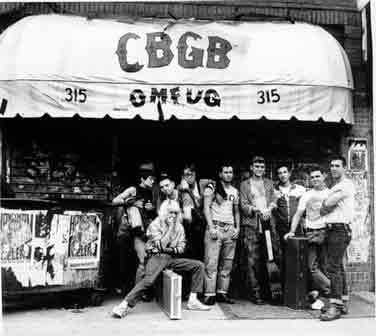
The iconic awnings from a French site
A couple weeks ago, on a school night, a friend lured me to CBGBs late to see what she promised would be a HUGE band. Well, the back-up band to a really huge band did show up, but I was happy to go, check out CBs one last time and firmly putting my late-night-music-outings life in the past.
The debate about its landmark status is interesting, mostly because it is fairly unremarkable on the outside, but is chock full with incredible, tangible layers of history on the inside. Everyone recognized the iconic awnings, but other than that, the building is unremarkable. The interior is amazing however. It would spill out of the club if not for the bustle and almost-arrival of the Bowery. The NYTimes notes the richness of CBGBs lavatories (did I just write that?), but the whole club does give you that feeling of entering another period of time. It's a remarkable feeling, actually.
from a Southern Illionis alternative rock station...?
I'm split on whether or not CBs should stay (the Bowery Resident's Committee shouldn't have tried to evict it the way it did, but does it have legitimate reasons to take over space because it wants to expand its programs? if so, negotiate terms BRC and CBs can be happy with), but whatever happens, the interiors should remain intact, which would be an architectural challenge whether it stays or goes.