Vancouver from the air
After thinking so much about urbanism in the Pacific Northwest and how it compares to New York, I was happy to see that ArchNewsNow published a well-articulated and thoughtful comparison on the very topic. No earthshattering conclusions, but several pragmatic observations.
9.21.2005
A Vancouver - NYC comparison

This is for the urbanists
Me too, me too!
There's something very eery about New Urbanism (e.g., Truman Show?). I'm not offended by Jim Kunstler, in fact, I like that he's not afraid of being crude, but I think there definitely something to the the idea of Jane Jacobs getting usurped by all types, as proposed by this blogger in Greensboro, AL.
Listening to what someone is really saying is a dying art. Nearly everyone, from ego-architects to New Urbanists, say that their vision comes from Jane Jacobs and those who repudiate her also seem to misunderstand what she's saying.
9.12.2005
A turn...
Everything seemed super frivolous against the backdrop of the ongoing aftermath of Hurricane Katrina, but the resignation of Michael Brown, director of FEMA is an indication to start hoping again.
[In the article, you'll see that Bush again defers to not having spoken to Brown or Chertoff when asked to comment..if only he would stand up for something at the time it happens!]
9.02.2005
The weight of helplessness
I've wanted to say something about Katrina, and yet after spending hours over the last few days reading about it and committing several hours last night watching footage from New Orleans, I find myself at a loss for words. There are so many angles from which this disaster is a complete tragedy. Miss Representation expresses it eloquently. How can it be possible that we are rendered so helpless in this situation? And for now, all we can do is contribute in the small ways we can and hope that contribution materializes into tangible assistance to the people in New Orleans.
8.31.2005
I love our National Parks

...and the National Park Service. We personally experienced the wonders of the National Park in Washington State and recently even in New York City, on Governors Island. We discovered talking to the Park Rangers that National Park Service jobs are the most coveted - and among the lowest paying - jobs in the field. Yet the workers do a spectacular job of making sure that we have access to a variety of beautiful, natural places to visit all over the country. These places are fundamental to reminding us that we are all part of something bigger, and I would go as far as saying that the National Park system is one of the greatest things about living in the United States.
And now it is under attack. The draft of the Bush Administration's new national park management policy allows for greater commercial and recreational activities that are inherently at odds with the National Park Service's mandate to protect our national parks. Yes, instead of "protect," the mandate has been shifted to "conserve," and it seems that conservation is for the benefit of humans, not of our eco-system.
As this New York Times editorial "Destroying the National Parks" eloquently states,
There is no question that we go to national parks to use and enjoy them. But part of the enjoyment of being in a place like Yosemite or the Grand Canyon is knowing that no matter how much it changes in the natural processes of time, it will continue to exist substantially unchanged.

8.30.2005
A vote for Vancouver
My plea for tips about Seattle led to the suggestion that I visit Vancouver instead. This Star-Tribune (Minneapolis) article - sorry, it is several weeks old - makes a very compelling case. It's here in its entirety, so you don't have to pay for it online.
HEALTHY BY DESIGN
Steve Berg | Star Tribune Editorial Writer
Published July 31, 2005
VANCOUVER, B.C.
http://www.startribune.com/stories/1519/5533882.html
Any busy downtown sidewalk will reveal the mystery of why Vancouverites
are an uncommonly vigorous and healthy bunch and why their city is so
widely admired.
Stand on Robson Street for five minutes on a weekday afternoon. Count
the people walking past: 346. Note the number who are obviously
overweight: 2. Estimate the number wearing backpacks: 100. Now take
another five minutes to count the cars moving steadily and easily past:
74 (plus two trucks and three buses). Reach for your calculator: 4.5
pedestrians for every car.
There you have it. Not exactly scientific proof, but an insight into
Vancouver's formula for healthy residents and urban vitality: more
walking, less driving.
More than any North American city, Vancouver has intentionally merged
public health with city planning. The goal is not just to promote
recreation (there are plenty of bike trails and tennis courts), but to
design physical activity into the daily routine, to build a city so
compelling that people will leave their cars at home, strap on a
backpack and take up walking as their primary mode of travel.
The result is a cityscape that's breathtaking in its beauty and
impressive in its retail vitality. Thick layers of trees and flowers
have invaded the downtown district. Strips of freshly trimmed green
grass line many downtown sidewalks. Hundreds of small shops and
restaurants have sprouted among the ever-expanding supply of townhouses
and high-rise condos. You can take a beautiful and pleasant walk to
fetch almost anything you need, so why drive?
Indeed, driving has become the backup mode of downtown travel. Growth in
auto traffic has lagged far behind growth in resident population, which
has doubled to 80,000 in the last 15 years. Auto traffic actually
declined by 13 percent between 1994 and 1999, according to a city
government study, while pedestrian traffic rose 55 percent. Last year,
vehicle registrations declined for the first time in memory as new
residents began eschewing second cars. Transit ridership, meanwhile,
rose 20 percent over three years. Air quality improved. And the
Vancouver region led Canada in many health categories, including life
expectancy.
"They built it and they live it," said Lawrence Frank, a planning
professor at the University of British Columbia and a leading expert on
the link between urban design and public health.
Both here, and earlier at Georgia Tech, Frank has been at the forefront
of research that ties obesity, hypertension, coronary disease, diabetes
and other health problems to the sprawling development and auto
dependence that dominates most cities. His and other research continues
to show that substituting even a modest amount of walking for driving as
part of the daily routine reduces the likelihood of obesity and related
diseases.
The greatest inducement to physical activity is living within walking
distance of shops, transit stops and other destinations, studies show.
In other words, urban form can induce a healthier lifestyle.
"Vancouver is the clearest example of that," Frank said. Critics suggest
that self-selection may have tilted his results -- that people who
choose to live in active cities tend already to be trim, fit and quite
literally "walking the talk." Frank acknowledges the point, but insists
that the policy implications remain valid. People will have a better
chance at a healthy life if cities build physical activity into the
urban form.
Vancouver owes its health-conscious design to a list of advantages that
most cities, including Minneapolis, don't have: a moderate climate, a
geography hemmed in by water and mountains, the relative racial harmony
among Vancouver's white and Asian ethnic groups, tax policies favorable
to renters and small business, a huge flow of Chinese investment since
the mid-1990s, and a contrarian strain of politics that engulfed the
city in the early '70s and continues to pay dividends.
"Those were the hippie-dippy days," recalls Gordon Price, an urban
planning consultant and former city councilor who says Vancouver
succeeds mostly because environmentalists kept freeways out of the
city's center.
As a result, traditional neighborhoods stayed intact; local streets
stayed vibrant and busy; crime was held in check; public schools and
small business remained strong. The city swallowed hard and accepted
high-density redevelopment as a way to preserve the wider region's lush
environment.
It was, in short, an early version of "smart growth" that ran contrary
to the trends of the day and to human nature. It would have been easier
just to acquiesce to sprawl, big-box stores and the auto lifestyle,
Price said.
Vancouver isn't without problems. Vagrants and drug addicts occupy
downtown's derelict eastern edge. Housing prices in the tonier West End
are leaving the middle class behind. Meanwhile, the outer ring is
suffering traffic woes common in most suburbs.
But what most impresses a visitor is central Vancouver's extraordinary
care for public spaces. While drivers tend not to notice, walkers are
drawn to beautiful spaces. They see their city close up. They won't
tolerate crumbling, weed-infested sidewalks or shabby neighborhood
businesses. The more walkers a city has, the more pleasant, safe and
vital it becomes. Every great city is a great walking city -- not only
through parks or along waterfronts, but along ordinary streets that link
homes and destinations.
For Vancouverites, the values of healthy physical activity, public
beauty and retail/residential success seem to have converged in a
perfect synapse.
How? A greenways program invests $1 million a year to build attractive
pedestrian and bicycle links between homes and destinations, sometimes
along "ordinary" city streets. In addition, the park system maintains
130,000 street trees as part of its impressive $80 million (U.S.) annual
budget, and the zoning ordinance requires private developers to devote 1
percent of construction budgets to public art, thus embedding scores of
sculptures, fountains and other artistic features into the walking
environment. Moreover, city planners routinely negotiate generous
landscaping commitments from private developers.
"They are expected to match the high standard that the city has set with
its landscape investments," said Sandra James, the city's chief
greenways planner.
The central idea in creating a healthy city, she said, is to make sure
that natural beauty isn't confined to parks and the waterfront but that
it invades every block.
Quoting the preamble to Vancouver's greeways policy book, she said:
"It's time to stop thinking of our cities as one place and nature as
someplace else."
Steve Berg is at sbe-@startribune.com.
(c) Copyright 2005 Star Tribune.

8.25.2005
Don't fall for Cal Thomas!
I'm sure the planning community is going apeshit over the August 17 column by Cal Thomas. The inversion of common values/principles versus government created by conservative politics really angers me, especially when it's really about protecting a "free market." It really really bothers me that they draw on the nostalgic image of a community lost to make their point. Don't fall for it! This market being defended is one that is free only to the privileged and powerful.
New York City Council blocks Wal-Mart's entree
There's a nice discussion in the LA Times about the New York City Council's attempts to block Wal-Mart by first refusing a variance earlier this year and most recentlying passing an ordinance requiring grocers to have minimum health benefit coverage that is distinctly non-Wal-Mart. Wal-Mart was not specifically named. Bloomberg came out against the measure due to its anti-free market bent. The New York University Law School helped write the policy, concurrently with a poverty study it is conducting.
This isn't a big stumbling block though. The company is actively looking for a foothold in New York City.
"Manhattan is a particular challenge, but we are looking at all the boroughs," said the company spokeswoman. "There already are big boxes in the city … Target is already in the city … as is Home Depot … They're nonunionized [and] doing well. And we want to be a part of the market as well.
"We're looking in Staten Island, Queens, the Bronx," she said. "We're looking all over the place."
8.24.2005
The gauntlet is thrown...
It's been too long since I last posted - there's been a few big changes at work. But I couldn't resist this: how many millions of people will rise to this challenge? John Tierney from the NYTimes says:
...I figure the long-term odds are with me. And while I'm at it, I'll extend Julian's challenge and consider bets from anyone else convinced that our way of life is "unsustainable." If you think the price of oil or some other natural resource is going to soar, show me the money.
8.18.2005
The dawn of township cooperation?
Development pressures in NJ are forcing townships to get involved across their borders. It's about time!
This article also gives very specific examples of the types of costs a town may have to undertake in order to support new housing development. One tends to think that it does go beyond new roads and sewage systems, but things like a new ladder to reach larger and higher houses and a new firefighter building to house the new ladder? That's an interesting glimpse into a township manager's life.

8.17.2005
Wal-Mart's quarterly earnings down...
...due to increased cost of energy (oil). Not so unusual in the world of business.
But look at this twist discussed in today's NYTimes article: Wal-Mart's big box business model depends on the customer's ability to drive to their stores (and indirectly, the government's ability to provide the transportation infrstructure to do so). Part of the reason it's earnings are down is because people can no longer afford to go to the stores.

"If you have to spend seven or eight dollars to drive to Wal-Mart, it had better be a big purchase," [Joel L. Naroff, the chief economist at Naroff Economic Advisers in Holland, Pa] said, "otherwise the savings won't be that great."
With its customers having grown accustomed to such consistently low prices, Wal-Mart could have a particularly hard time passing on the higher energy costs - both its own and those of its suppliers.
"Wal-Mart made a living jamming costs down on everyone else...Now, how much can they absorb on their own?"
8.15.2005
I wanted to (heart) Seattle

Seattle. It was the place everyone talked about as the promised land. The land of neighborhoods, of balanced streets, of waterfronts, of inclusive, participatory local government - it was the Eden of urban living. I really really wanted to love Seattle.
Instead, surprise. Disappointment. Maybe disappointment is inevitable after a set-up like that. OK, OK, the downtown is better than most. The city government is organized around its neighborhoods. If you love recreational water activity, there's plenty to do. There are many many good things about Seattle. And I really didn't get too many days there. (For those who know Seattle, I stayed in Belltown and went to Pike Place, Pike/Pine, Capital Hill (Broadway District), Ballard, Fremont, Seward Park, Lincoln Park, Alki, Gas Works Park, Columbia City, Pioneer Square and the International District).
But I don't want to make those equivocating statements about Seattle. I want to LOVE it. The experience of actually being on the streets and experiencing the city was just not as full as I expected. People don't hang out on the streets because they all drive around. Traffic is really really bad, but you have to get right into it (by car or bus) to get around. I was often the lone pedestrian (among many many homeless), even at the height of pedestrian times, like from 5-6PM or 8:30-9AM. And I guess I just like to learn about a city by watching the people who live there. I didn't get to do much of that.
There are spectacular places, such as Pike Place Market, but walk just a couple blocks away, and it goes back to bland and boring office and condo buildings. Many recommended neighborhoods provided the same diluted effect. They seemed to consist of a main street with some cute or high-end restaurants, maybe a bar or club, and some boutiques. A pedestrian might be drawn down the street, but that experience ends abruptly at the invisible retail district line. The spillover and overlapping effect doesn't happen in Seattle.
And finally, the biggest surprise of all, is a positive one. I liked the Seattle Public Library. Compared to all the other really crappy buildings downtown that are without an iota of public space, not even a nod to their inherent participation in downtown public life, the library provided so much more. There were people waiting for the bus next to the library. The metallic looking webbing stood out among all the other buildings, sort of like a wayfinding device. I could find the entrance. I knew where to go upstairs. Could it meet the sidewalk more elegantly? Sure. The inside wasn't quite as functional as people have claimed either (lots of handmade wayfinding signs, and by the looks of them, crafted by librarians who were attempting to answer some questions before they were asked). But I sure didn't hear any other criticism about the general overall design of downtown buildings. Many of them are worse!
There seems to be so many good, substantive parts to the City. But they just don't link well to each other, and I found it hard to take one positive experience and continue threading it throughout the city. I had to start building the positive one place at a time.
Maybe I'll go back one day and see the light. I really want to. (By the way, our drive across Washington State was spectacular.) Send Seattle tips my way!
8.12.2005
PPS's First Fundraiser
I'm back in NYC and in the throes of preparing for PPS's little fundraiser next Wednesday. Plase come out and support PPS if you are in NYC. If not, help us furnish our office! This is PPS's first ever fund-raiser and I know people in the office don't think people will donate. I personally think we have a good cause, even if we don't always get everything right, so come out if you agree.
Of course, I'm way behind with writing, but I have lots on what I saw out in Seattle, across Washington State, and in Coeur d'Alene. I also missed lots of great writing from NYC and elsewhere, but I'll try to catch up over the next few days.

8.07.2005
Off line
Preparations for a trip to Washington State and Coeur d'Alene, Idaho for a wedding were accomplished so last minute that I didn't get a chance to say that I'm on vacation until next week. There.
8.01.2005
China's built environment: enormous negative impacts
I'm horrified but not surprised by this article about the terrible reslts from China's intense push on industrialization and built environment.

7.31.2005
On our waterfront: from Sunday Times 'City'
I've become a huge fan of the City section of the NYTimes. First, I was a Style junkie (before living in NYC), then of the Real Estate section last year, but there's only so much pining I can do, so now I reach for the City section first. I love the clips from neighborhoods. There's always a genuine human angle to the stories, less "news at 10," more personable.
Today's City section highlights a couple of waterfronts: LIC and Tribeca. I especially liked what Tom Fox, the president of New York Water Taxi and founder of the Neighborhood Open Space Coalition, said of his effort to bring some activity to LIC's waterfront. Of the beach he set up, Fox said, "This is the kind of stuff that brings people to the waterfront...And once they're on the waterfront, they get invested and it becomes their waterfront."

Some honesty about downtown Brooklyn
(This rendering from NYC Dept of Planning makes the whole thing look more innocuous, doesn't it? Don't be fooled!)
When I read this Metropolis article about Brooklyn's proposed downtown development, I couldn't wait until the online version was released so I could share it. Kudos to Karrie Jacobs for being honest about change in her backyard.

7.30.2005
Elizabeth at Spring

Update: I just liked this little sign with the suggested rainbow behind it. For some substance on the building, visit Personism's post, or, the granddaddy of stories behind the building, Curbed.
7.28.2005
More on consumption

This is a little indulgent. I find that I catch stories that fit into my amateur theory (and I acknowledge, it's well explored in a much more complex manner by true social scientists) that our consumer purchasing trends and culture shape our built environment.
I just like watching how it happens. That's why I like that self-storage fluff so much. So, ta-da, a couple that fit the bill...
From the country that clings to its town squares and pedestrian linkages, a "smart mall." - Christian Science Monitor
We can't give up our cars, so let's make our cars different, how about it? - NYTimes
Self-storage: a new context?

Do you ever walk around a neighborhood with old, beautiful loft buildings, only to discover that Manhattan Mini-Storage already outfitted the entire building with hundreds of self-storage units? (Think: Hudson Street off Canal). And it's not just here. While I was on Virginia's Eastern Shore, a much less consumer-rich region, I heard that the growth of self storage buildings there now competes with the tomato crops. This NYTimes article tells us why:
"As competition for commercial real estate has intensified, investors are gravitating toward self-storage because it offers initial yields of 7 percent or more, well above apartment buildings."Well. I never knew. And now how about some blending in:
"These are chameleon-like projects," said Ariel L. Valli, an architect in Aliso Viejo, Calif., whose firm has designed 350 storage facilities, including the elegant Spanish-style Date Palm Storage in Cathedral City, outside Palm Springs. "They need to blend in - - in size, shape, texture, color landscaping. Then they are better received."Ah, making it easier for us to buy, store and forget about it.
7.26.2005
New York City's public spaces
I have a backlog, but thought this was worth posting right away. Harvey Robins, former aide to Mayors Ed Koch and David Dinkins, offers a vision for New York that focuses on public spaces, and the funding to do that. I'm not experienced enough in city budget management to know if this would work, but I always like it when people offer alternatives, not just criticisms.
7.21.2005
Word, Costco
Well, Costco builds ginormous stores, but at least the company offers a more livable employee policy. The folks at theboxtank offer some good insight.
7.20.2005
Eeks! East Village, Vegas-style
The news hit last month, but these photo-sims are astounding. Need I say more?
Via Curbed, where you can view more pix.
And officially from the Las Vegas Business Press.

7.19.2005
A smart growth and sustainable Wal-Mart?
After the fascinating discussion about politics and the use of language to frame issues in this past Sunday's NYTimes Magazine, I guess I shouldn't be so surprised to see a Wal-Mart representative frame their newest store in Texas in this way:

"We see it as a next step in evaluating the impact we leave on the environment as we look toward smart growth and sustainability in the building of our new stores," said Mike Duke, executive vice president and chief executive officer of Wal-Mart Stores - USA. "This store will contain many of the best resource conservation and sustainable design technologies currently available to minimize the use of energy and natural resources."Here's what Wal-Mart is focusing on to make the store "sustainable:"
* Reducing the amounts of energy and natural resources required to
operate and maintain the stores
* Reducing the amount of raw materials needed to construct the facility.
* Substituting, when appropriate the amount of renewable materials used
to construct and maintain the facility.
Smart growth? Sustainable? Conservation? Minimize use of energy and natural resources? The most obvious breaches of those goals is the store is still new construction in the middle of nowhere, out of scale and off center.
Still, I don't want to be only the naysayer. It's good that they're monitoring the environmental impact of the store; stay tuned for more gooey factoids from this part of Texas. And this is a nuanced issue: check out the story about Vancouver rejecting a "green" Wal-Mart.
7.15.2005
Michael Sorkin offers 10 alternate sites for NYC's "stadia"
I'm prone to just accepting Michael Sorkin's jaunty yet hard-hitting prose. There's something about it that makes you want to believe and I find myself at my most uncritical. So here, he weighs in the future NYC stadium, offering 10 alternative sites after first condemning public subsidization of big projects. See if you can resist.

7.14.2005
Finally, the good kind of attention on Atlantic Yards
From Naparstek.com
Aaron Naparstek writes thoughtfully in the NY Press about the limelight on the Atlantic Yards...the kind of limelight that one hoped would shine on this important project.

7.12.2005
Oil and more oil
Today's NYTimes talks about China's alarming and growing dependency on oil, NJ's crumbling transportation infrastructure and its inability to fund future repairs, and increasing oil prices against complacent consumer behavior. The sentence that stays with me is from one of the interviewees who drives an SUV:

"That's like having an obesity problem," he said, "and being told you need a smaller shirt."This is the counterpoint to the oft-used analogy about widening roads, likening adding another lane to getting bigger pants as a means to solve a person's obesity problem.
Obesity isn't necessarily an inept analogy - afterall, the U.S. transportation infrastructure and policies are a true reflection of our habits as consumers both in our demand for it and our inability to fund it. But as any seasoned public health official can tell you, consumer behavior is one of the most difficult things to change. Uh-oh.
Rich people + McDonald's = McMansions???
This year's award for "Dumbest Column to show up in a Glossy." Among the choice phrases that helped garner the prize: "Since 80 percent of Americans live in metropolitan areas, aren't they at least 80 percent guilty?" You'll recall the New Yorker article (pdf) that illustrated how people living in denser settings actually make fewer demands on natural resources. Too bad the author is so intent on pitting rural dwellers against urbanites that he misses the bigger opportunity to highlight the intrinsic interdependence that we - urbanists and ruralists and those in between - all have on our natural resources.
7.08.2005

Let's try this out in NYC

I really like this - it's nothing edgy, just a simple idea. Vienna and the merchants association allowed artists to try covering all brands on a busy shopping street.
Sure, the artists won permission by arguing that the merchants would experience an increase in shopping because everyone would be curious about the exhibit. (So persuasive were they that the Chamber of Commerce became the biggest contributor to the project's $245,000 budget).
Delete! web site
7.06.2005
Take back the streets...
...so this is what happens when I am out playing - missed out on this great commentary by John Massengale on NYC streets last Friday. And the PPS opinion on our beloved streets.

7.01.2005
Muggy MoMA

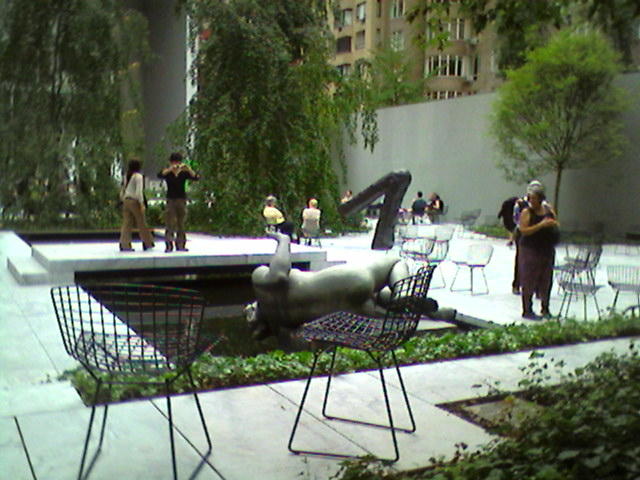

I finally took some vacation-at-home days and paid a long overdue visit to the MoMA. We love sitting in the cafe overlooking the sculpture garden, and we ended our visit with a few minutes in the garden, which was closed when we were last there.
The MoMA has inspired some of the most passionate dislike from my peers and friends, but I kind of like how the people rough up the spare lines of the building. It feels very modern, and the museum has become a place onto its own...there were plenty of people eating lunch in the garden that weren't there to visit the galleries. Maybe there are parts of the museum that are lacking, but on a muggy June day, it was the place to be.
An opening at SFAA
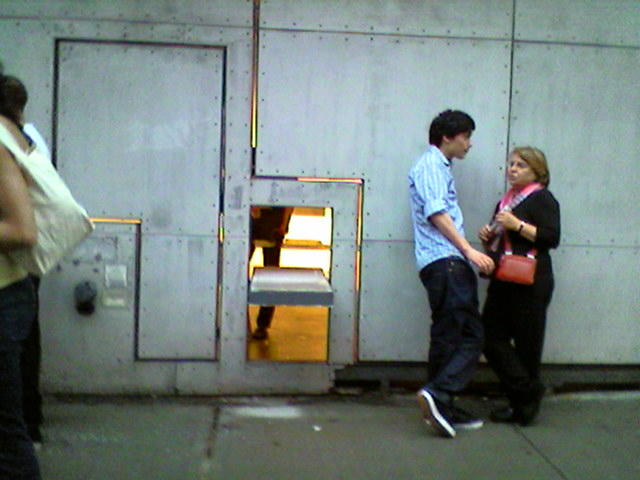

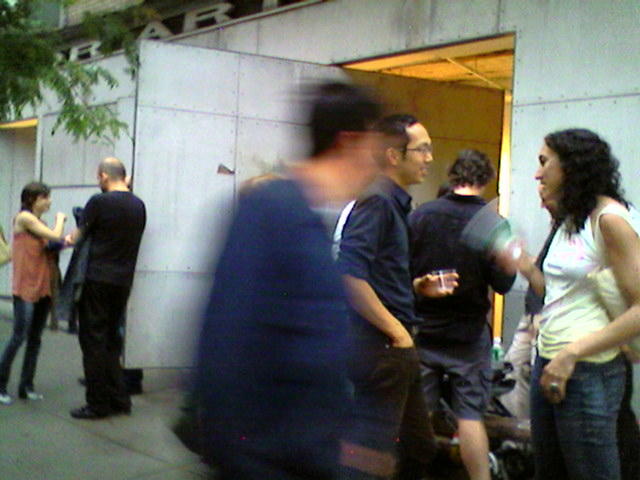
Finally, after months of walking by and wondering what it looks like open, here it is....Storefront for Art and Architecture....open.
6.29.2005
On FDR, East River developments and Ousourroff...
I'm just catching up with the writing now...really, great discussion from John Massengale who writes about the suburbanization of NYC and removing the blight that is FDR and Miss Representation on trying to uncover the "true" design intent behind the East River development.
Beyond Jacobs
We had a bit of a debate this morning over yesterday's Ouroussoff NYTimes article about the East River waterfront proposal. There are some who go back to the (now) tired old argument that design critics are too aesthetically-driven, leaving the function and use of the space untended to. OK, we've heard that song before. The rest of us (me included) were simply puzzled by Ouroussoff's writing.
Let's really think about this: isn't Ouroussoff setting up a false truth? A Jacobian legacy doesn't immediately connote sentimentality and nostalgia. She was an activist in her day, and she didn't necessarily prefer one design to another. Mostly, she worried that neighborhoods were not being thought about with the lense of people and the attendent uses, comfort, sociability, etc were being forgone in the name of what her opponents called "modern."
What Ouroussoff wrote in complimenting the proposal was completely in line with Jacobs:

"Even as it celebrates the city's underbelly, it weaves it into the surrounding neighborhoods with remarkable sensitivity. The plan shows how a series of small interventions, when thoughtfully conceived, can have a more meaningful impact on daily life than an unwieldy urban development scheme."If Ourossoff wanted people to stop paying attention to sentimentality, why continue to evoke an outdated notion about Jacobs? Come on - of course young designers have innovative ideas about what it takes to make a city great, and they're best suited to come up with small interventions rather than large civic projects. After all, they're used to making a lot out of not very much at all.
Jacobs ideas were about innovation and change, not accepting the status quo destruction that was so quickly happening around her. We can continue to live that legacy of embracing change and imbue that mentality with a humanist perspective, only we've got to move beyond the false duality of to preserve or not. There is no time to argue about sentimentality - can we just talk about what works?
See PPS for the official opinion, where you can comment too. Or comments welcome here!
6.23.2005
The north end of Union Square
Photo by www.laneyb.com
I guess I've been doing a bit of NYC focused things lately. I went to the Union Square BID annual meeting a couple mornings ago, and there, heard mentioned off-handedly that Van Valkenburgh Associates is working on tweaking their design of the north side of the Square (which will not be shown to the community board?!). Iris Weinshall, Commissioner of NYCDOT was also there, and she mentioned that DOT was doing a study on the transportation of the site. (Kudos to Union Square by the way - it's come a LONG way. Some of the statistics they flashed were amazing - over 1.1 million people use the transit station underground each week; 30,000 people walk through the south side of the square each day; and 100,000 people visit Whole Foods every week, advance apologizes if I'm missing a digit or two, it was kind of early.)
At no time did either party say that they were aware of the other's study, or that they were interested in collaborating with each other. Am I missing something, or does it seem obvious that they should?

The Fear Factor
"Given the slippery nature of the threat, the security debate at the Freedom Tower should move beyond architectural design."Yes. True of all buildings beyond the Freedom Tower.
NYC: Incapable of "big projects"?
A journalist tried to provoke me the other day by suggesting that New York City didn't have the conviction, determination, savvy, smarts, and even guts to push through a "big project." By big project, he meant a stadium, or a modern architectural wonder, anything, anything, dear god, that would show the world once and for all that New York City, the city of big egos, can build something as big as it talks. There is definitely an undertone among architectural circles that there isn't any "good" new architecture in New York City.
We have to get away from this big mentality. What's so great with always shooting for the big? The big projects take the largest amount of resources for the smallest amount of immediate, and in many cases, long term, gratification and benefits. Given the long length of time that they require for the building process, they tend to fall short of meeting the needs of realities in the future year when they are finally realized.
Regardless, I think NYC has succeeded at things bigger than big projects. Big projects tend to serve the interests of a narrow band of privileged people. I think the bigger challenges are to serve more people with fewer resources, something NYC has been successful at doing.
As a city of small cities, towns, villages and neighborhoods, NYC has improved the ability of the smallest micro-neighborhoods to succeed and become destinations in their own right. Crime rates are down, schools are undergoing an experiment in improvement, property values are going up, and people are investing in the city economically and socially. There are more people coming to the city now who stay in the city because it is a good place to live. I have spoken to countless taxi drivers who thought they would leave once they made their foundation, only to find themselves being able to carve out a good life in the city. Check out the Mayor's Management Report. (Sure, it's election year, so all the more reason to find out what he's trying to sell.)

Eminent domain reigns preeminent
Devastating ruling from the Supreme Court on a case from Connecticut. The Court ruled that local governments have the right to seize private property to make room for any development even if it does not have a clear public goal. Sandra Day O'Connor in her dissent:
"Any property may now be taken for the benefit of another private party, but the fallout from this decision will not be random," she wrote. "The beneficiaries are likely to be those citizens with disproportionate influence and power in the political process, including large corporations and development firms."
6.13.2005

Gentrification vs reinvestment from CNU
Gentrification is a complicated issue: definitions abound and the topic is one that brings out the most impassioned diatribes about how neighborhoods should develop. Discussions easily lead to polarizaion. Here's CNU president John Norquist's perspective.
The thing is, gentrification as used to denote the outpacing of neighborhood improvements against conservation of existing positive aspects of the neighborhood, bears the blame for too many other broken social systems. (Gentrification is also over-used to generalize, which is really the point of Norquist's op-ed.) Improvement efforts that occur with enlightened developers, through asset-based community development, through collaborative city agencies, through a partnership between the neighborhood and the city, are typically perceived as the exception to the norm. There isn't a comprehensive system to recognize indigenous neighborhood assets, to protect, integrate and utilize those assets for positive improvement. But there isn't one single way that a neighborhood should be improved either.
Gehry garners CNU award for Urban Design
(Thank you John Massengale for the very appropriate image!)
Huh?
Read all about it at City Comforts.

6.03.2005
The High Cost of Low Price
Robert Greenwald (producer/director of Outfoxed and Uncovered) will release a new documentary, The High Cost of Low Price, on Wal-Mart's far-reaching negative impact on communities throughout the world. Stacy Mitchell, a senior researcher with the New Rules Project writes:

"Local and state governments have provided billions of dollars in tax breaks to fund big box development. Tax policies in many states allow national retailers to avoid paying much of their income tax, while local businesses must shoulder their full share. Wal-Mart and other chains have also benefited enomously ... from a host of policies that subsidize sprawl at the expense of older business districts."From Lisa Smithkline, an organizer working with Brave New Films, Greenwald's production company:
"The issues aren't right or left -- they cross all the usual barriers, uniting communities that simply ask Wal-Mart to respect their residents and businesses. From gasoline retailers who ask Wal-Mart to play fair without using predatory pricing practices, to family business owners who ask for cities to provide the same tax incentives and a fair playing field. Workers, teachers, mothers, students, independent newspapers, manufacturers, and members of every faith tradition have united in an unprecedented and creative campaign to offer Wal-Mart the opportunity to negotiate a fair place in their communities."Turning up the heat on Wal-Mart - AlterNet
Taking On a Giant (Whistleblowers Welcome) - NY Times
Wal-Mart Focus of Documentary-Cum-Indictment - theboxtank
6.02.2005
Chasing the American dream
There's a facsinating NY Times series on class running right now. Yesterday's article highlights upper-middle class "relocation specialists" - people who move for the sake of the job and lifestyle, people who seem to have it all, yet still remain dissatisfied. Of the family profiled,

"The Links are the first to say they have not really found a way to make their Alpharetta life work. They found good schools, safe streets, neighbors they like and a big house and a yard. But they did not count on the grueling traffic, on how far away everything seems, on how much is asked of volunteers to sustain the community, or on the stresses of a breadwinner's travels. They have no deep connections here, no old friends, no parents to sit for their children."What's interesting to me is how the physical characteristics of their daily lifestyle - suburb of Atlanta, suburban housing developments - has inhibited their ability to build meaningful social capital.
I'm not talking about the mere act of relocating. I'm thinking about what happens when these people move, what they have to do when they get there. I'm thinking about the milk run, the school run, the soccer run, the bible study run, the tennis club run - all those daily little trips that this family has to make. Fundamentally, it seems that these relos are placeless though they try desperately to root themselves to whatever community they live in. Our transportation and land use decisions have become barriers to the Links' ability to fulfill, in its entirety, the life that they seek.
5.25.2005

DestiNY where the sun doesn't shine
Grist uncovers a new entirely green shopping mall development, DestiNY, built to be dependent on solar-power, and yet planned for the fairly unsunny region of Syracuse, NY. (I know because I grew up there).
While all of it sounds good and makes for great publicity, much like a Made in Hollywood couple a la Tom Cruise and Katie Holmes, don't you wonder why these well-intentioned people won't just put their time in resources in something more meaningful. There's really no need for more malls in Syracuse - what it needs is some care, collaboration and nurturing in its downtowns. Montreal experiences nearly the same weather patterns and there are people outdoors for much of the year.
Also, when this structure is completely powered by sun, what happens when the region experiences one of its many long streches without sun? Why not just take all the government backing and invest in the downtown and making it more walkable and accessible? I guarantee that people will go downtown even when the sun doesn't shine.

Cities aren't doing as well as you think
"Two major things need to happen in order for cities to be saved. First, they must undertake a CAT scan of sorts, which would reveal, underneath the glossy exterior of arts centers and arenas and hip downtowns, the reality of lost jobs, dysfunctional schools, and crumbling infrastructure. Second, they need to acquire the political will to attack these issues head-on despite the inevitable roadblocks."In his latest article in the New Republic (registration required), Joel Kotkin isn't nearly as dire as Mike Davis, contrary to what the title would have you believe.
5.24.2005
Update on Seattle Public Library
The library seems to be holding up well. I was happy to learn that the librarians were heavily involved with the design of the space. There are some minor cosmetic issues due to the high volume of users (8,000 daily visitors on average), but nothing super major. It's still early yet, but this building's programming (uses and activities) will definitely help it survive the test of time.

5.21.2005
Busy week
We've been busy with events this past week, so I have had no time to post at all. In fact, the participants were telling me about news in New York...and that's how I found out about Trump and the WTC, sad to say. (I did manage to get Jane Jacobs' letter up, below.)
People from all over the United States and Canada, with a few people from other countries (Denmark, the Netherlands, and South Africa) came out to New York the past couple of days. This is my fourth time doing the workshop, and this is the first time that I felt that the notion of "placemaking" is mainstream, or at least, it's no longer a lone "voice in the wilderness" as someone else put it.
Yeah, yeah, transportation people are into it (if by words only), as well as the predictable developers and architects who are after resorts and lifestyle centers.
But the idea is fully resonating with people less obvious - those working in affordable housing, the people looking out for seniors, designers hoping to move away from graphic and product design for corporations and get more involved with helping communities through design, and librarians. The ideas are acceptable, not "hippy," and these are the people who are active users and shapers in their communities, not just builders of the physical environment. These people are wondering how to work with their government and with the professionals.
What does this mean for my microscopic world? I want to get us on Oprah!

Letter from Jane Jacobs to Mayor Bloomberg and City Council
From Brooklyn Rails:
Letter to Mayor Bloomberg and the City Council
May 2005
Flowers trump towers at the Brooklyn Waterfront Festival, April 24, 2005.
BR Ed.’s note: The following is a letter written by Jane Jacobs to Mayor Bloomberg and the City Council about the rezoning of the Williamsburg-Greenpoint waterfront. As modified during the May 2nd negotiations between the Bloomberg administration and the council’s Land Use Committee, the plan now calls for some industrial retention and makes nonbinding, incentive-based provisions for affordable housing. Jacobs’s key point about the contradiction between the rezoning and the goals of each community’s 197-A plan remains valid, however. Here is the entire letter.
April 15, 2005
Mayor Michael Bloomberg and all members of the City Council
c/o City Council President Gifford Miller
Dear Mayor Bloomberg,
My name is Jane Jacobs. I am a student of cities, interested in learning why some cities persist in prospering while others persistently decline; why some provide social environments that fulfill the dreams and hopes of ambitious and hardworking immigrants, but others cruelly disappoint the hopes of immigrant parents that they have found an improved life for their children. I am not a resident of New York although most of what I know about cities I learned in New York during the almost half-century of my life here after I arrived as an immigrant from an impoverished Pennsylvania coal mining town in 1934.
I am pleased and proud to say that dozens of cities, ranging in size from London to Riga in Latvia, have found the vibrant success and vitality of New York to demonstrate useful and helpful lessons for their cities—and have realized that failures in New York are worth study as needed cautions.
Let’s think first about revitalization successes; they are great and good teachers. They don’t result from gigantic plans and show-off projects, in New York or in other cities either. They build up gradually and authentically from diverse human communities; successful city revitalization builds itself on these community foundations, as the community-devised plan 197a does.
What the intelligently worked out plan devised by the community itself does not do is worth noticing. It does not destroy hundreds of manufacturing jobs, desperately needed by New York citizens and by the city’s stagnating and stunted manufacturing economy. The community’s plan does not cheat the future by neglecting to provide provisions for schools, daycare, recreational outdoor sports, and pleasant facilities for those things. The community’s plan does not promote new housing at the expense of both existing housing and imaginative and economical new shelter that residents can afford. The community’s plan does not violate the existing scale of the community, nor does it insult the visual and economic advantages of neighborhoods that are precisely of the kind that demonstrably attract artists and other live-work craftsmen, initiating spontaneous and self-organizing renewal. Indeed so much renewal so rapidly that the problem converts to how to make an undesirable neighborhood to an attractive one less rapidly.
Of course the community’s plan does not promote any of the vicious and destructive results mentioned. Why would it? Are the citizens of Greenpoint and Williamsburg vandals? Are they so inhumane they want to contrive the possibility of jobs for their neighbors and for the greater community?
Surely not. But the proposal put before you by city staff is an ambush containing all those destructive consequences, packaged very sneakily with visually tiresome, unimaginative and imitative luxury project towers. How weird, and how sad, that New York, which has demonstrated successes enlightening to so much of the world, seems unable to learn lessons it needs for itself. I will make two predictions with utter confidence. 1. If you follow the community’s plan you will harvest a success. 2. If you follow the proposal before you today, you will maybe enrich a few heedless and ignorant developers, but at the cost of an ugly and intractable mistake. Even the presumed beneficiaries of this misuse of governmental powers, the developers and financiers of luxury towers, may not benefit; misused environments are not good long-term economic bets.
Come on, do the right thing. The community really does know best.
Sincerely,
Jane Jacobs
*This is too good to be true...is it real? Thanks Teresa!
5.12.2005
What does City mean?
Kotkin laments the loss of the middle class in San Francisco, and reads its loss as the result of the growth of upscale bars and boutiques - the ephemeral city. Cities are definitely changing, isn't that why we're spending time writing about them? This romanticized lamentation, though, seems to be a moot point.
John King answers back, reading the shifting city as just another evolution in urban development. He's not accepting it as good necessarily - he just notes the change as complex and stimulated by factors beyond the city's boundaries.

"Take the loss of dockworkers: Burly laborers weren't chased from the waterfront by the folks running that silly caviar bar at the Ferry Building; they're the victims of the shipping industry's shift from loose cargo to sealed containers in the 1960s."And ephemerality? I can't think of another institution pushing ephemerality more to the middle class than those national chain theme restaurants and stores that you see everywhere not in cities throughout the United States. Applebee's, Pizza Hut, Ruby Tuesdays, TGIFriday, Outback Steakhouse, Starbuck's - the list goes on and one. Our nation's landscape has become eerily recognizable anywhere you go.
At least the city's restaurants - theme parks, if you must - are more human-made, and not so dominated by the projection of a single culture defined by corporations.
Also see theboxtank's comments.
5.10.2005
"Restoring Neighborhoods, Rebuilding the market"
photo by Jasper Goldman, Manhattan Skyline from Greenpoint/Williamsburg waterfront
A great article with strategies for directing investment in "blighted" neighborhoods.
To mull over with the rezoning of the Brooklyn waterfront...

What place for Design(ers)?
John Kaliski writes in the Harvard Design Magazine, "the planning discourses of everyday life and professional plans for the form of the metropolis gradually become one. “Everyday” people are asked to consume and form opinions about everything from large-scale infrastructural decisions to tot lot beautification. Information is posted online and citizens—particularly those that are obsessed—know that armed with this data they too can be experts. Even with the consequent focus on the local and the self-interested, this process nevertheless sets up the planner to play a key facilitation and brokering role. This is not easy given the microscopic viewpoint of much of the citizenry, but it is possible, even as it demands new planning practices and frameworks, in essence the construction of a “New Planning” for consensus building and decision-making."
Kaliski is patronizing about the viewpoints of the "citizenry" but nonetheless, he's right that designers do have a new role, as does design.
Landscape Magazine pulled together PPS and representatives from the landscape architecture community in Seattle to discuss the relevance of design in the revitalization of a derelict Seattle Park. Probably one of the first times the two sides went face to face.

Great Places, great ideas
Tom Vilsak, the governor of Iowa, signed an executive order establishing The Iowa Great Places Initiative. "In short, this process will pick three visionary plans for transforming and enhancing Iowa "Great Places" and then put $12-20M worth of state departmental money at the dispoal of the winners to bring these ideas to fruition."
"Great Places" is designed to make good places great by bringing together the resources of state government to build capacity in communities, regions, neighborhoods or districts that cultivate the unique and authentic qualities that make places special: engaging experiences; rich, diverse populations & cultures; a vital, creative economy; clean and accessible natural and built environments; well-designed infrastructure; and a shared attitude of optimism that welcomes new ideas, based on a diverse and inclusive cultural mosaic."

Mom and Pop NYC
Thanks to Matt Lipsky from the Neighborhood Retail Alliance for forwarding me the new blog and web site about small businesses in New York, Mom and Pop NYC. From his message:

"On the blog we will be commenting on various New York City political issues especially as they relate to neighborhood-based small business and community character. On our website you’ll see our history of fighting for the interests of small business including our recent campaigns against Wal-Mart and to preserve the Bronx Terminal Market."Definitely a worthy read - this group does great work.
Musings: Fringe culture in real estate hubs
Last weekend was the one when everyone decided to hold events, so we found ourselves going from one place to another in the city. First we hit The Tank for some hyper-alternative comedy courtesy of Tremendous Rabbit and the Weiner Philharmonic. Then we went out to East Williamsburg where an loft/resident/performance space hosted a night of electro-punk music. The next night we went to a classical music concert at a high school on Irving Place.
Culture aside, the places themselves were fascinating. The Tank, housed in a former gas station, is currently under threat of losing its space because development of Times Square is quickly spilling over to the edge of the island. Not surprising, really, though sad as it is one of the hipper spots in midtown. Out in Williamsburg, a few people live in the loft space full-time, but perhaps for a cut in rent, they put up with 50 or so people listening to loud music and hanging out in their living room on weekends. We were told this is an "illegal" loft (a la Williamsburg-Bedford stop in the 1980s), but the only illegal aspect I could fathom is that they collected money at the door and we had to pay for our drinks. Otherwise, it could be any standard college party.
Finally, a switcharound - a somewhat dying culture in a hot area. The Irving High School hosts the Peoples' Symphony Concerts. It's well known that classical music audiences decrease dramatically every year, so it was nice that we could go listen to some avant-garde music performed by eight blackbird just down the street from Irving Plaza (where the line snaked around the corner).
5.02.2005
Potential for Lower Manhattan, in spite of LMDC
Nicolai Ouroussoff writes in today's Times:

"...the Lower Manhattan Development Corporation has steadfastly refused to open up discussion on the site's overall organization. Not only has it sought to prevent the architects from speaking publicly about their ideas, according to several architects interviewed, but it has also warned them against sharing their ideas with one another, saying that this would be a breach of their confidentiality agreements.I have to agree, though I think the flaw in the design process started even earlier, with the selection of the architects and in planning out the rebuilding. With this clamp down on information sharing -- especially as it becomes ever more critical that the larger group focuses on needs of future tenants, programming, uses, etc -- it's hard to understand why any of the designers were initially chosen (outside of their brand names, of course).
...This constitutes an enormous squandering of talent, as well as a total disregard for how the creative process unfolds. And it has essentially shut the public out of the process."
It's good to see that there is some desire to collaborate - now, if only they could.
4.29.2005
When a neighborhood becomes popular

There is the story of gentrification in New York, increasingly complicated by many factors. I'll give the back of the cereal box version: the intensifying dirth of affordable housing for a larger swathe of people, not just for low-income households; immigration patterns, which of late show that new immigrants who traditionally moved out of the city once they got a foothold are now staying in the city to take advantage of its services and amenities provided by either the city or de facto by communities; and shifting local economic development patterns.
Our neighborhoods are changing - quickly and for everybody.
And community organizing reflects this change. Where once upon a time it was the old school community organizers that tried to either shut out the "artist", "hipster," you-name-the-trendy-group, we're witnessing newer groups adopting the same goals but in a very different way.
Take Williamsburg, for example. I don't know why the Village Voice's article "Discovering Williamsburg" is news, since the community has been collaborating since at least 1990 to stem the tide of gentrification that came with their success in turning back the tides of disinvestment from the 1970's, and people on the Southside have been worried for decades. Now, in addition to the traditional community organizing groups, St. Nicholas Neighborhood Preservation Corporation, Greenpoint Waterfront Association for Parks and Planning, the Southside Mission, the People's Firehouse, the North Brooklyn Alliance, among many many others, there's the Williamsburg Warriors taking charge of a very different form of community organizing. (Is that why it's news?)
I don't know the Lower East Side as well, but in addition to the Lower East Side Tenement Museum, the LES BID, the Lower East Side People's Federal Credit Union, among many, many others, there is now LOCO.
These groups - Williamsburg Warriers, LOCO - are onto something I really really like. They have to take the history and traditions of community organizing that probably came out of the 1970s movements and couple them with the new - ways of accounting for new people, of growing local businesses, of dealing with new symptons of success, such as movie shoots. They're new resources for these neighborhoods which have been a little stuck. They can sometimes come up with innovative ways of dealing with standard problems (check out the YIMBY post from yesterday).
I wonder how much of the older organizers efforts affected the formation of the new, though I very much hope that the new groups share the limelight with other like-minded organizations in their neighborhood.
4.28.2005
YIMBY!!!
= YES in my backyard.
The Park Slope Neighbors group negotiates with Commerce Bank to change its design. Back in December, the group found the original proposed design horrible and unacceptable for the neighborhood (very Micky D's). At first, it seemed like it would be a case of NIMBY, but since then, the group decided to go with a more positive approach: it said that it would embrace the bank's presence if it changed its design to be less strip mall and more in context with the Park Slope neighborhood. Yeah for YIMBY.
The bank agreed. A new design was released. Great press was generated. Park Slope Neighbors transferred its account to the Commerce Bank!!
THE END
Endpaper: The design is still bank-y, but at least the entrance and overall structure are more transparent and geared towards pedestrians, a vast improvement over the original fast food drive-thru model. Customer parking is in the back, instead of the front.

Undulating curves in Astor Place

under construction, via wirednewyork.com
Gawker is the snarkiest one of them all, and that's why its take on the Astor Place sculpture-architecture is so indulgently enjoyable.
Paul Goldberger mentions how the building would meet the street:
"where the squat limestone base tries too hard to fit into the surrounding streets"but I wish he would fill out the thought some more, even a paragraph more. His comments about the structure feel right though, as I look at the cheesy reflective glass everytime I walk through Astor Place.
4.26.2005
Conventions, arenas, you name it
An article on sports arenas and a round-up of some of the newest developments around the country. For a good analysis on New York City region arenas, check out Miss Representation's version.
And for those who want a little bit more substance, a City Journal article on the economics of convention centers. Bottom line? Convention centers do not improve local economies.
...and why parts of Brooklyn are just terrible
from the Greensward Foundation
On one of the past few beautiful Sunday's, we made our way to Prospect Park. The walk from the Q train up Flatbush Avenue was pleasant enough, (though we did not even think about crossing the street as Flatbush was rather daunting, with its racing traffic, inconvenient crosswalks and multiple lanes of two way traffic) but when we got to Grand Army Plaza, "the grandest of park entryways in New York City's answer to the Arc de Triomphe in Paris," we became muddled and then very annoyed.
The park entrance is within sight - the most obvious thing is to walk directly through the roundabout where the Arch is. Yet that was impossible - there was no facilitation (crosswalks, pedestrian signals) to do so. To get to the park entrance, the crosswalks told us to walk all the way around the archway and cross five wide streets. The "grand" archway is not an entrance - it's an obstacle!
Whatever happened to Grand Army Plaza? Some old photographs show that it was always paved (initially with cobblestones?) and with cars on it too, but perhaps for much slower moving carriages. What has happened, it seems, is that this beautiful entrance has been totally given over to facilitating thru-traffic, without any consideration for other types of traffic - pedestrians and bikers, other than keeping them away from cars. Whoever made the decision didn't seem to notice the Brooklyn Public Library at the corner, or the Prospect Park's main entranceway, both of which don't allow cars inside. From what I remember, Paris' Arc de Triomphe was similarly addled. That's why you enjoy it from a distance.
I'm sure this issue been played out over and over again - and people living near Prospect Park learn to put up with it because the Park itself is so lovely, and well worth the trip. I know people not living in Manhattan drive more, and are underserved by public transit. Still, that's no reason to continue to give drivers complete right-of-way and not look out for bikers and pedestrians, especially at such critical pedestrian destinations.

Subscribe to:
Posts (Atom)

