2.06.2010

2.01.2010
Make Bike Buddy a reality
Vote for this project - $250,000 at stake! We all know that when there's more cyclists on the road, there is greater visibility, fewer crashes and ultimately higher prioritization of bike-friendly city policy on all sides - infrastructure, enforcement, etc.
Yes, I know at least a little bit about all the big picture stuff on why biking is good - climate change, global warming, urban transportation systems ... but starting to ride in a dense urban environment can be really intimidating, especially in the beginning.
Just orienting yourself to the street - which side is best to ride on? What about an avenue? Skirting buses? Handling left turns? How do you let drivers know your movements? What's actually safe?
Then all the prepping to get on the bike: what to wear - for work, for evening parties, for long rides, to City meetings. How to stay warm or cool, what's helpful vs. extraneously cool (or dorky) gear. What should I use to carry my stuff, where do I go to buy those things? When my bike breaks down, what's something I can fix on my own and something I should take into the shop?
I was incredibly lucky to be surrounded by a large group of seasoned bike commuters when I started riding in NYC nearly two years ago. I literally had a "buddy" who was willing to work out the small details with me, like best footwear while riding, to big decisions, like which routes are the safest. People met me in the morning and rode home with me at the end of the day and at night, never resenting the fact that I doubled their trip time since I rode so slowly. They patiently showed me how to change the tube in my tire endless times and would give me a tune-up while they were at it. And after a few months (and only a few mishaps, like when I nervously stopped at a stop sign, got rattled at the too-close shy distance with a fellow biker and literally fell over slowly and sideways on top of him in front of 10 aforementioned cyclists), I started to get the hang of it.
I couldn't imagine living in the city without biking now. Riding has become one of the best ways for me to get around, live, work, and play in New York. I would love for every new bike commuter to have the same experience of getting up to speed. Go Bike Buddy!
p.s. An individual email can vote for the same idea 1 time every day during the entire voting cycle from February 1 - 28. Please vote!
1.31.2010

1.24.2010
Here it is, a plan to plan
I knew someone had figured this out. Absolutely, the first response is not one of reconstruction...here's some ideas for the long-term.
1.21.2010
Hm...at least it's now serving bus riders

image source
...and not just car drivers, but on the plus side, this also prevents people from circling around looking for a spot...but still. You have to give to get. Check it out: Roadify, a service for community transportation driven by user-input. I like the idea of BusAroundMe, now possibly augmented with MTA data?
1.18.2010
In public service
This is a little rumination I've been sorting out, so apologies upfront for the rudimentary nature. If I've been workshopping in my head, BttN seems to be a good spot to lay everything down and geek out.
I've been spending some time thinking about the multitude of ways planners can contribute to change; learning about the situation in Haiti has made it more immediate. (To be honest, I was also inspired by the Bauhaus exhibit at MoMA where examples abound of workshopping and testing the flex of combining multiple disciplines to contribute to society.) Other professions have figured out a succinct and valuable way to apply the skills of their profession for public service. Examples of those groups include Medicins sans Frontieres/Doctors Without Borders, Union of Concerned Scientists and Architecture for Humanity. There are myriad smaller organizations that do similar work: engineers working on eradicating TB, architects working on affordable, community-based sustainability, for example. All of these groups are emblematic of specific knowledge and skills applied to a specific situation. Sometimes the need is much more immediate, as in Haiti. Other times, it's a longer-term need. Doctors may be the only profession with a common oath; however, it seems that the creation of the organizations is an implicit recognition that many other professions also have distinct power through their specific knowledge to save lives and make people's lives better.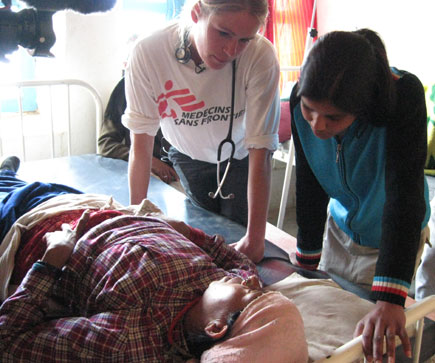

What would a so-called Planning Corp do? Sorting through this brings up more questions than answers. Fundamentally, what do planners do? They help make decisions about how the built environment will be formed, how the natural and built environments will relate to one another, and all with the goal of making people's lives better. Planners collect data, and conduct research and analysis against an understanding of space. How does planning happen? Through a series of decisions, sometimes through an established public process or a private development process, usually a combination of both. How do those decisions get made? What's required to make them? Yikes. The arc of planning always seems long-term; what do planners have to offer in the short-term?
(In disaster situations, there must be (hopefully?!) a typology of responses that has been established among relief agencies. The process of response also carries with it a geo-political context. For example, without knowing the particulars, the decision to cede control of the airport to the U.S. seems loaded. Who gets to go into Haiti - what groups? Who receives access to resources to set up and has legitimacy to be there? Who decides?)
Planners often get lumped with architects and designs. A quick look through the Architecture for Humanity opportunities list shows that the focus on the building facility first; the design process proceeds from that starting point. Architects probably take on a huge amount of the planning responsibilities too, but it's hard to know where that starts and ends. There's Architects, Planners and Designers for Social Responsibility too; role? It would be interesting to follow-up with folks who worked on the Katrina reconstruction and see what lessons and best practices could be found.
I think it's dawned on everyone that the practice of planning needs to extend beyond the effort of making the planning process more inclusionary - or maybe the definition of inclusion needs to be expanded. Though that aspect of planning is absolutely necessary, planning as a discipline seems to have to make a bigger change than just getting community input per se.
Outside of physical design, planners also deal with a lot of data - from how it's defined to how it is collected to how it is communicated. I've become more and more curious about open data and the politicalization of analysis and access, thanks to the nudging of a couple of good folks in NYC. I guess it's about time! In this vein, the CrisisCamp response to the Haiti situation seems extremely appropriate and efficient. The application of data across space is very much an exercise in planning - but participation seems very much defined by computer program developers, not planners (the CrisisCamp folks made a great effort to include a role of non-techies in the projects).
Mobile app developers working on Creole/English tool at Haiti CrisisCamp DC
So I'll put it out there: what do you think a Planning Corp would do? If planners had to band together to respond to crisis, to injustice, to social change, in the long-term and short-term, what would they bring to the world? Sometimes I try something more specific: what would the Hippocratic Oath be for planners? And finally, what's missing here?
1.13.2010
Grand Army Plaza - book release!

The fine folks at Design Trust for Public Space have released the book (free download available) on the Reinventing Grand Army Plaza design competition. The book looks wonderful - they always kick out stellar publications, those people.
If you'd like to get involved with the ongoing improvements at Grand Amy Plaza, there are a lot of opportunities through GAPco, the community-based coalition led by residents, business owners, elected officials, and among them, quite a few folks who are experts in public space and transportation. The first meeting is coming up soon...check the web site for updates.
This is a great example of organizing, coalition building, ideas design competition - all leading to physical changes in this space.
1.11.2010
For the love of bikes
Recent industrial design Pratt grad Vanessa Marie Robinson has a few great ideas to make biking easier, safer and much more stylish up on her awesome blog, for the love of bikes.
A cool bike bag with expandable helmet area...
Reflective riding gloves that don't scream spandex warrior...
A bicycle tool utility bench for our tiny NYC apartments...

1.08.2010
New old news

source
Britta/Window Farms reached its fundraising goal!
Another discussion about defining blight...
What is Affordable Housing?

Center for Urban Pedagogy only gets better and better. It launched this new project, Envisioning Development, that investigates first, "What is Affordable Housing?" Awesome!! Check out the map. Looks like Zoning and ULURP are next in line...
From CUP:
Our work grows from a belief that the power of imagination is central to the practice of democracy, and that the work of governing must engage the dreams and visions of citizens. CUP believes in the legibility of the world around us. What can we learn by investigation? By learning how to investigate, we train ourselves to change what we see.Yes, yes, yes, and yes!
1.07.2010
Modern Shipwrecks
"My belief is that uncertainty brings about a heightened awareness of place." - Marie Lorenz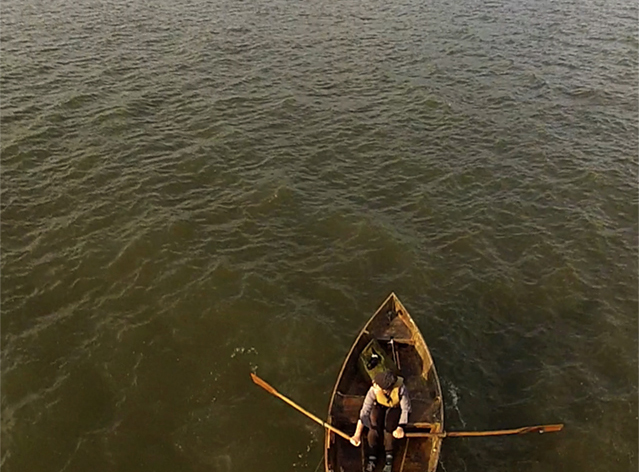
Anyone who's traveled to a different country knows how much this rings true. I heard Marie Lorenz's talk at the Gel conference back in 2007; she was one of the more memorable speakers. I love her deep commitment to the basic theme, which is a simple idea - build boat, explore shoreline - with the experiences extremely unpredictable. Her execution is impeccable. Simple ideas really are the most brilliant. 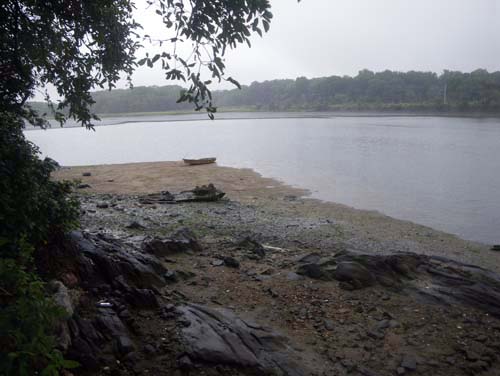
Read her statement and go through the many trips (and maybe one shipwreck) she has taken on the shorelines of New York City. You can view her most recent shipwreck at her opening tomorrow night, January 8, at 6 PM at the Jack Hanley gallery.
1.05.2010
Narrow streets experiments
One can always dream...

westwood boulevard + pico boulevard, west los angeles
...fun to check out.
Looking for good people
Transportation Alternatives is looking for a few good people to intern and hire.
12.29.2009
Down to (vendy) business
A message from Sean Basinski, Director of the Street Vendor Project:
A couple weeks ago at a holiday party, I heard someone describe the Street Vendor Project as "that group who puts on the Vendy Awards."Read more about Mohammed and a request for micro-lending.
I was impressed that he knew about our big yearly event, which continues to thrive and grow. But I was frustrated that the Vendys had again overshadowed the work we do at SVP every day, organizing and advocating for hundreds of vendors who will never receive an award but deserve our recognition and assistance just the same.
One of those vendors is Mohammed Ullah, and immigrant from Bangladesh who sells roasted peanuts near Times Square. With no vending permits available, Mohammed can´t open his own business - the cart he works belongs to his boss, who pays him $60 to $70 a day. He lives in a small apartment in Brooklyn with his family.
12.24.2009
Another one
Am finding endless awesomeness this week (in spite of the wack).
Yay for Candy Chang. Her projects are amazing and the process really illuminating...connecting a design product to advocacy. Yay! Thanks Urban Omnibus for pointing her out again.


(I'm a softy for the Street Vendor Project too. This year's at the Queens Museum was worth the trek.)
12.23.2009
Scattered Light

ASDF designed six posters.
One poster will be released a month.
Each poster has a photo by David Horvitz on one side and a text on the other. Together, the photo and text present various themes relating to the concept of space/place/surroundings.
Each poster release serves as an open call for photographic responses. The response should be based on the poster's text and image, along with an “Assignment”. The “Assignment” is announced with the poster release / open call. These open calls are open to everyone who wishes to participate.
Assignment 1
Opening up process with open (specific) data
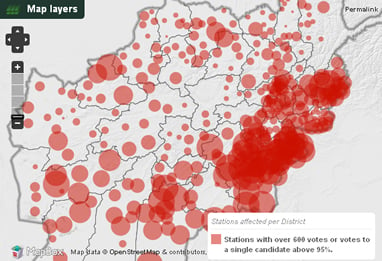
I visited DC a couple weeks ago and hung out with my close friend/doppelganger who works at the National Democratic Institute (NDI). She seems to have no end of interesting projects, but one of her latest, mapping voter data from Afghanistan's November 7 elections, in partnership with DevelopmentSeed, is really amazing. You can play around with some of the results at Afghanistanelectiondata.org.
The issues barring democratic civic engagement in Afghanistan are obviously different than the ones that we face in the US. I think the lesson here is that you have to identify data collection/visualization with a heavy dose of political strategy that's connected to influencing the change you want to see. She and I bandied this around a bit; she's a master at political strategy and can talk you through/out of anything you might think is a brilliant idea (<3 her!)
OK, duh I know, but how many times has data been collected/analyzed/visualized to look cool but still doesn't seem to say very much or remains disconnected to advocating for change? For example, I'm looking at the viability of inserting health impact assessments (HIA) into the planning process for local development projects. Yes, conceptually it totally makes sense. But when you drill down, identifying the most valuable public health indicators becomes really hard. Plus, what difference would a HIA make in NYC's ULURP or CEQR process without advocating for changes in those outdated processes as well?
It doesn't matter how big or small the project is; identifying the specific data needed to create the change in the specific political/cultural context is absolutely necessary. Sometimes simple is good, or the best. Getting to simple specifics is the hardest part of the thought process.
(Whoo-hoo, congrats cc!)
12.20.2009
Green It Yourself
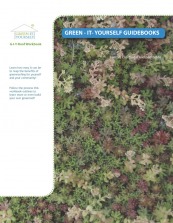
My partner in the Grand Army Plaza design competition, Lori Gibbs, and the talented Atom Cianfarani, just finished another project that promotes local sustainability - a DIY workshop book on green roofs, part of their Green It Yourself series. They break down the process and language of this kind of project and give you lots of pointers on what is absolutely necessary and what can be more flexible as you design your greenroof. The greenroof workbook is available now; they'll sell green roof supplies on the same site soon. Congrats!