
Sustainable building practices are no longer new, but the tone in the public consciousness is still one of discovery.
Here's the latest "trend" article from the NY Times.
4.30.2007
A wave of green building
Carnegie Mellon U and Pittsburgh
I finally put up the photos from Pittsburgh. I focused on Carnegie Mellon University, as it is one of the most "green" campuses in the country. I had a mission: to find out where students gather. I do believe that greening goes hand in hand with creating spaces that people want to use, and I found this effort to have mixed-results on campus.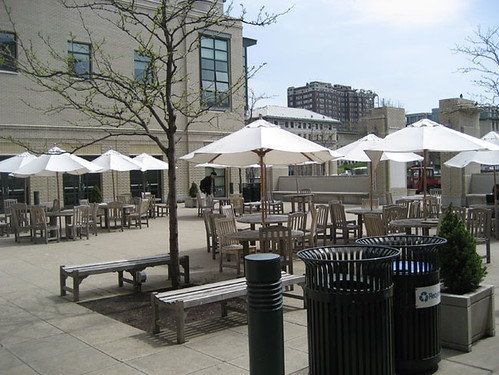
My tour started at the relatively new building, the University Center, which serves as a kind of student union for the students. It was a beautiful day, but where is everyone? The seating and shading of this courtyard is great, but I think the tall walls around each side of it serves more as a barrier to sitting than it does as a privacy screen.
Some more students here: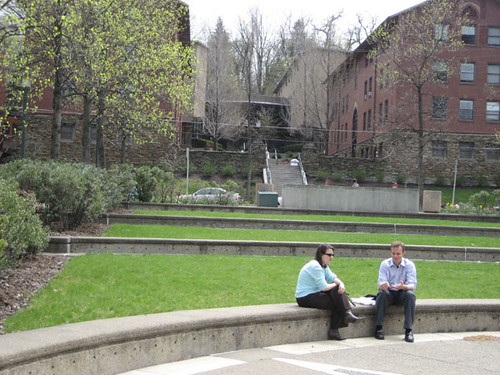
here: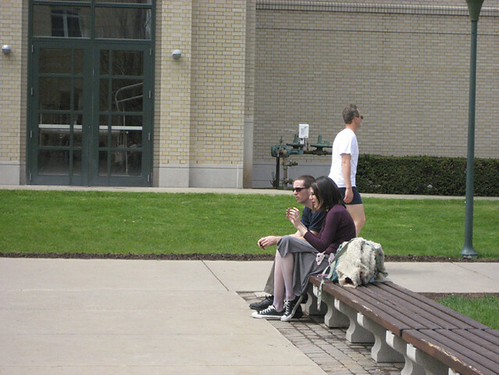
and here: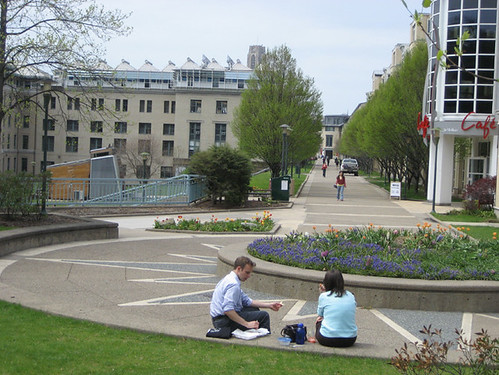
...but not what I would call solid "gathering."
I stumbled onto this spot which had more student concentrated in one spot than I've seen all day: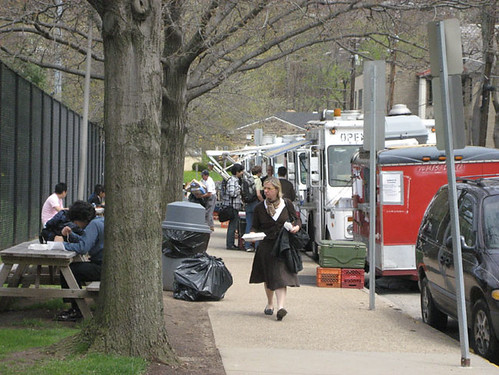
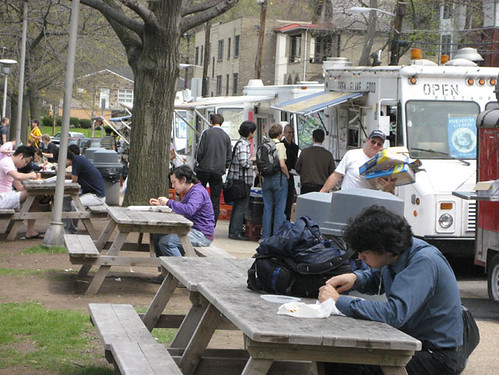
It was adjacent to a new cafe that was heralded as a "green" cafe, but not many people sitting in here: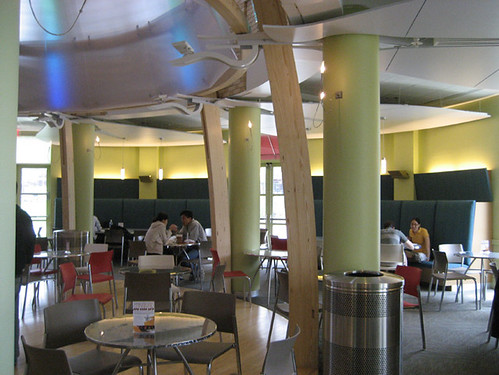
Just goes to show that food helps, but doesn't create, a successful public space. I have more pictures of where students sat together, you can check out my Flickr page.
My favorite picture of the bunch is in an adjacent neighborhood, where this couple was waiting for the bus. Apparently Pittsburgh has a really great public transit system with its buses, to the extent that this couple, who appears to be the kind of couple that might care about how they look getting from one place to the next, would ride it. Yes, a gross generalization, but I can only wish that I will look this elegant waiting for the bus.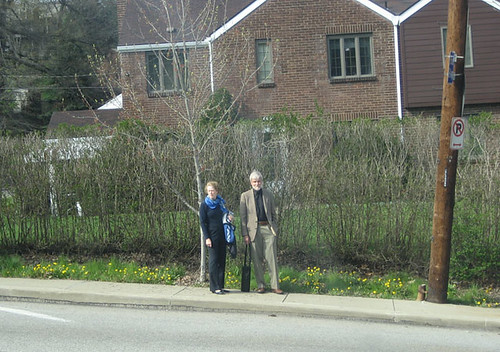
4.26.2007
Thank you!
Thanks to the folks who came out last night to our Jane Jacobs memorial event. We had a full room with a lot of new faces. It was wonderful to meet new people who are doing great things for the city, including folks from the Municipal Art Society, The Next American City, Columbia's Urban Technical Assistance Program, the Center for Architecture, the Council of Senior Centers and Services of New York City, and of course the Rockefeller Foundation and the newly formed Urban Design department at the Department of City Planning. Thanks in particular to Darren Walker (pdf) (who only had two hours of sleep the night before!) and to Alex Washburn for talking about the Jacobsian legacy and the future of New York City. Hope to see all of you at the same time next year.
4.17.2007
Good experiences

Magnolia tree in the Clinton Community Garden
I'm pre-occupied this week with the gel 2007 conference and a retail branding breakfast panel. I'm doing a walking tour of public spaces in West Midtown for gel, and I'm most excited about getting to visit Clinton Community Garden. If I were a participant, I would have had a hard time deciding what to do. If you miss the gel conference in New York, head out to Copenhagen this fall. It's always fun to put your common sense back to work.
Jane Jacobs and Other events
Don't forget the Jane Jacobs event next Wednesday, April 25 at 6 PM at the White Horse Tavern.
Plus, there's two interesting events for you on Tuesday, April 24. The third Green Apple Talk at the Strand will feature one of my favorite journalists, Aaron Naparstek, who is currently editor at Streetsblog.
Second is the vowel-less LVHRD GRN event.
I will have to miss both of these events. I'll be at ULI's conference on sustainable development in Pittsburgh. I'm so excited to see Pittsburgh.
4.13.2007
Most popular architecture blogs
Bird to the North just found out that it is No. 18 20 - of the 2007 most popular architecture blogs. Thank you Eikongraphia! I'm honored to be in such great company. I always thought BttN was something like No. 637; can't be anything but pleased about being Top 20.
Update: This is a very international crowd - which is terrific! Also, is it a very male crowd? Is BttN one of the few female-authored blogs up here?
Also, to be very frank, I never intended this blog to be about architecture, though of course the built environment is about architecture. So it's interesting to be listed - and I'm still pleased as punch.
UPDATE: April 25 - Jane Jacobs Gathering

A quick reminder to mark your calendars on April 25, for the Jane Jacobs gathering at the White Horse Tavern. Alex Washburn, the newly appointed Chief of Urban Design, will be joining Darren Walker from the Rockefeller Foundation to give us a quick presentation on urban design challenges for New York City and the inaugural Jane Jacobs Medal, respectively. Everyone welcome, no RSVP necessary.
Wednesday, April 25
6PM
White Horse Tavern
567 Hudson St. at W 11th
Words of wisdom

I went to an event yesterday hosted by Interior Design Magazine, all about the business of design. Though the day was packaged with discussions of brand extensions, product development, and business people getting through the design process, the highlight was getting to hear Sergio Palleroni speak. He is the founder of the BaSiC Initiative, which is about building sustainable communities through design. I'm catching onto this late, as he has received so many accolades that they are too numerous to list here. One thing that he said yesterday, which I found to be very emblematic of his work is that "the future depends on millions of small solutions."
I like the concept of bringing design to the people, or the community as designers. I am lukewarm about the business interpretation of it, which sometimes means more products more of the time. Sergio Palleroni's approach is another perspective which shows that more design for the people does not mean more waste, but less waste or even zero waste.
You can catch one piece of his and his student's new furniture, which involved turning reclaimed wood from Katrina into furniture for the New Orleans community at the Cooper Hewitt Design Museum next month. You can learn more about his work with his students at BaSiC.
4.10.2007
Zero
Everywhere we turn these days, people are talking green this, green that. All the major design and architectural conventions this year have green as the theme. Yet already for a few years now, this trend was accompanied by talk of green as vapid marketing hype, all surface, no sustainable substance, perhaps illustrated by TV catching on. Green sells.
Now we're heading towards zero. No Impact Man has made a significant impact. Our firm is talking about carbon-neutral, living buildings and design, being green is not enough. Seth Godin sums it up: zero is the new black.
4.09.2007
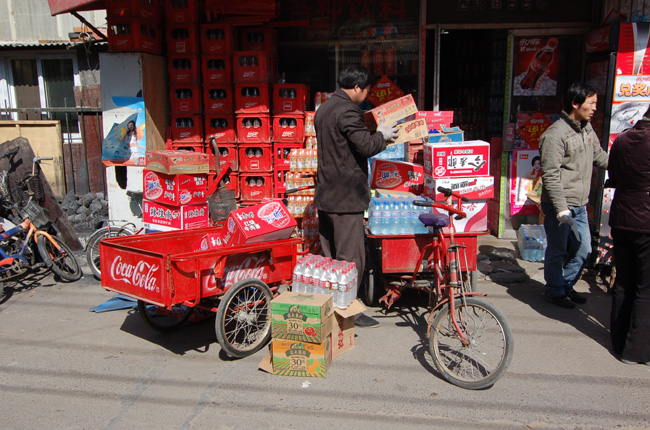
Bring back the trikes
Look at these ingenious ways that trikes have been able to cart people and objects around Beijing. via designboom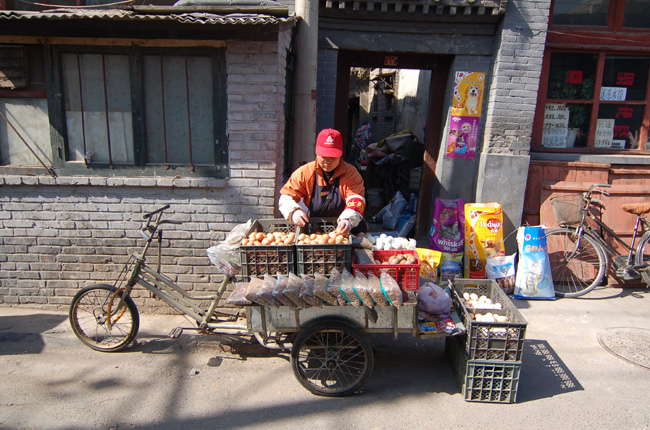
Shifting art and architecture

I like this interview with Olafur Eliasson, who I have mentioned here. I like his experiments with space and experience. About his work,
Looking into the future, Eliasson sees opportunities for a new kind of practice, that actually looks just like his one: a combination of art and architecture that could attain a ‘new responsive criticality’, working from an engagement with reality. Not socialist, not left wing or right wing, but to provide people with the sense that their lives matters, and that they are part of a community. Social and environmental sustainability. And laughing: ‘Art shows the way’. To finish: ‘I have a dream that content wins over form. I don’t want to kill form completely, because that is what my work is about, but almost.’
4.07.2007
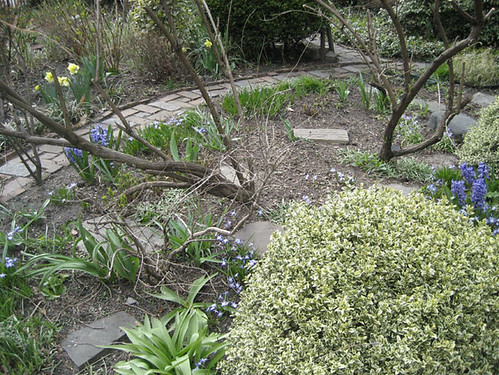
Liz Christy Community Garden
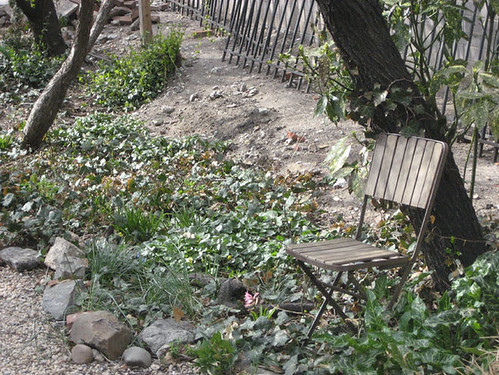
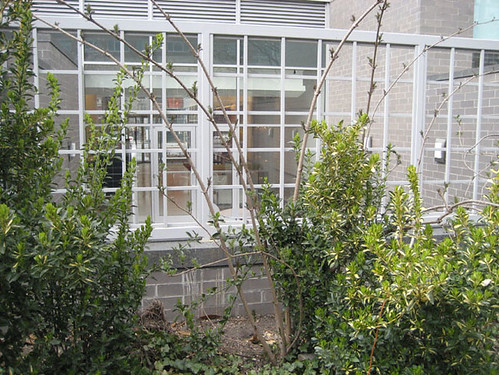
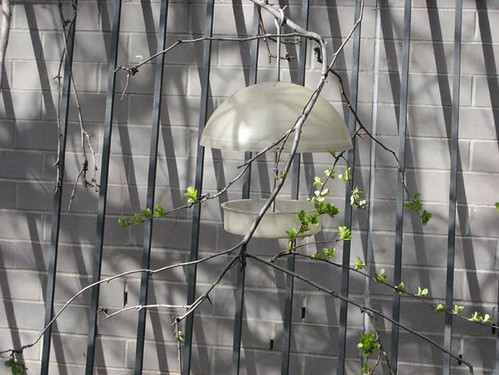
The first signs of spring in the Liz Christy Community Garden. It looks like the garden is growing to the end of the block, at 2nd Ave. Hurray if this is true. There is a gate to a private patio at Avalon Bay. Can the community use the patio?
UPDATE: The community cannot use the patio, but the garden is growing! It will stretch from Bowery to Second Ave along Houston. 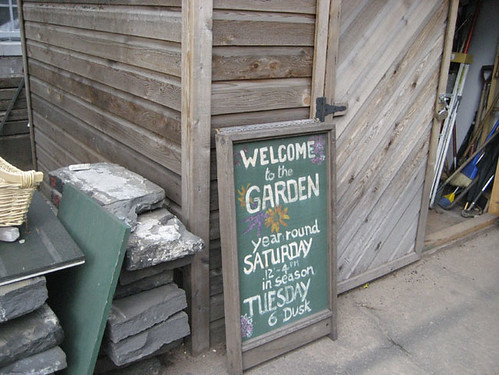

The whole set...
4.06.2007
Proposal for Grand Army Plaza


Images via Streetsblog
I love going to Prospect Park but contending with Grand Army Plaza on the way there is enough to keep me away. There's a great discussion on Streetsblog about recent proposals that are meant to improve the pedestrian and bike experience. The proposal is an improvement on the current experience - there are more stable islands where pedestrians can wait and those holding areas are going to be prettified, but it is also fairly clear that cars continue to have priority in this public space. The improvements seem to be concentrated on what happens to circulation once you enter the vehicular area, and doesn't show the experience from the approach.
Regardless of the many nays, I hope some improvements will be made in the short-term. Still, I can't wait for the day when Grand Army Plaza is conceived as the spectacular entrance to Prospect Park, instead of a roundabout to connect the streets.
via Streetsblog
4.04.2007
Save the Date - April 25 - Jane Jacobs

Lisa Chamberlain and I are hosting an event to commemorate Jane Jacobs. It will be on April 25, on the anniversary of her death. It's been so long since we've seen some of our compatriots - that means you urban bloggers, writers, activists, and designers. So come out and remember a lady that continues to inspire us to care for our cities and communities.
April 25
6 PM
White Horse Tavern
Hudson at W 11th St
Darren Walker from the Rockefeller Foundation will be on hand to talk for a few minutes about the Jane Jacobs medal, and we're hoping to confirm a couple more speakers who will speak about the City's vision for neighborhood development.
Everyone is welcome, no need to RSVP, pass it along.
4.02.2007
Wal-Mart: Impossible to be green
Stacy Mitchell from the Institute of Local Self-Reliance argues that there is no-way that Wal-Mart can be green - it's as basic as its fundamental business model:
In January alone, Wal-Mart opened 70 U.S. stores. At current growth rates, by 2015 Wal-Mart will have enlarged its domestic footprint by 20,000 acres, turning CO2-absorbing fields and forests into stores and parking lots. Big-box stores make incredibly inefficient use of land. While 200,000 square feet of retail spread over several two-story downtown buildings with shared parking takes up about four acres, a single-story Superstore of this size, with its standard 1,000 parking spaces, consumes nearly 20 acres.Regardless of their ability to cap carbon emissions, big-box stores still eat up way more land than other retail models.
Recycling for the public
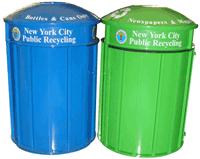
The City just announced a public space recycling program. Though I thought at first this meant that we were recycling old tire swings from playgrounds into surfacing, what it really means is that recycling receptacles will be put in public spaces so you can get rid of the newspaper you just finished on the train, or that plastic bottle you just drank out of.
It's about time!
It's still in an experiment mode, but I hope it gets through this stage quickly and rolled out. Recycling bins should be as ubiquitous as trash cans.
You'll find the recycling bins at:
* Bronx: Poe Park
* Brooklyn: Columbus Park
* Manhattan: Union Square Park & Whitehall Ferry Terminal
* Queens: Hoffman Park
* Staten Island: Tappen Park, Cloves Lake Park, St. George Ferry Terminal
Subscribe to:
Posts (Atom)